Forex rollback.
The Forex trend never moves in a straight line, as statistics show, a trend is 70% composed of pullbacks and only 30% is the main trend.
A Forex pullback is a price correction in the opposite direction of the main trend, followed by a resumption of movement in the direction of the prevailing trend. The magnitude of such a movement directly depends on the time frame being traded: the longer the time frame being analyzed, the longer the pullbacks.
A pullback is determined quite simply; it is enough to look at the chart of a currency pair and identify the main movement of the trend. All fluctuations in the opposite direction will be a correction, and the length of the corrective candle can sometimes exceed the length of the candle in the direction of the trend.
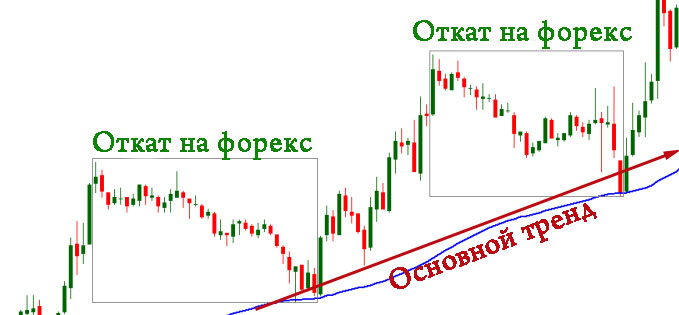
This concept is key when trading on any exchange, as pullbacks are the primary cause of losses in most trades. Therefore, it's crucial to distinguish them from the main movement.
A typical situation that one observes usually unfolds like this: a trader opens a 15-minute chart of a currency pair and sees that by all indications the price is moving downwards and the market is in a downtrend. A sell trade is then opened, but the price reverses, and the position immediately begins to incur losses. This would not have happened if the trader had looked at higher timeframes and seen that the trend on the M30 and H1 charts was steadily moving upwards. This means that on the M30 chart, there is a pullback against the trend, which on the M15 chart was perceived as the main movement.
Therefore, when trading, it is advisable to use the so-called "Three Screen Rule," considering the price movement not only on the current timeframe but also on the two adjacent ones.
However, there are no rules without exceptions, and any Forex pullback can become the beginning of a new trend if it lasts long enough and there are significant reasons for a trend reversal. It is the presence of such reasons that allows us to distinguish a simple correction from a trend reversal.
Trading on pullbacks.
This trading approach is also common in trading, but it's quite risky and is primarily used on short timeframes when working with a scalping strategy.
to find entry points , and trades are opened as soon as the price reverses against the main trend.
This strategy is quite risky, as the magnitude of a pullback in Forex isn't fixed. If the previous correction lasted 20 pips, the next one may last only 10 pips, and the main movement will likely force you to close the trade at a loss. This is because the next price fluctuation will be in an even more unfavorable position.
The least risky and most profitable option is to enter the market at the end point of the correction, when the trend reverses in the main direction again.