Resistance level (resistance level).
One of the most important concepts used in technical analysis on Forex is resistance. This indicator underlies many trading strategies and is widely used in stock trading.
Resistance level (resistance level) is a point or line on the chart of a currency pair that characterizes the maximum price value for a certain period of time, upon reaching which the trend reverses.
The longer the price fails to break through this level, the more significant it is considered, and the likelihood of a breakout increases, after which the trend will continue to move upward.
Resistance level options.
1. Point – in this case, the maximum price indicator (maximum) in the reporting or previous time period is used as the maximum level value.
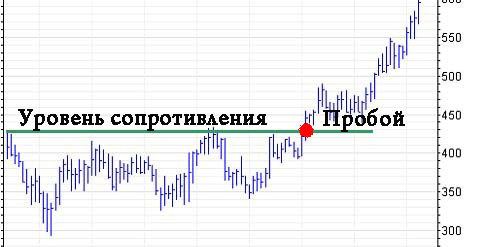
For example, the EURUSD currency pair's price high for the previous day was 1.3000. Today, the price is moving within a range of 1.2940 to 1.2990. However, yesterday's value of 1.3000 dollars per euro is considered a more significant resistance level.
Therefore, when placing pending breakout orders, it makes more sense to specify their trigger value in the range of 1.3000 - 1.3020 dollars per euro.
2. Resistance line – allows for a more complete assessment of the trend dynamics, but at least two significant highs are used to construct it.
This line can also characterize the current trend direction on the working time frame. Extending it beyond the current price value reveals the near-term potential for its movement.
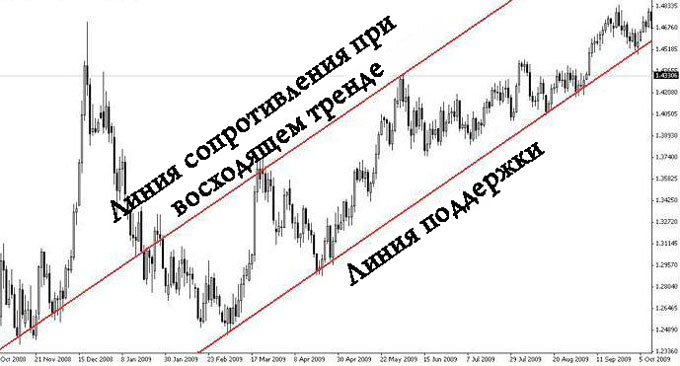
Resistance lines are plotted using built-in tools in any trader's terminal.
After a breakout occurs and the price moves higher, the resistance line becomes a support line.
Trading strategies.
Breakout trading is the primary strategy used when using resistance levels. It implies that if a trend has been unable to break through a certain price level for a long time, then a breakout indicates a high probability of continuation. This rule serves as a signal for opening new Forex positions. This trading strategy is fully described in the article "Breakout Strategy."
Pullback trading is a counter-trend strategy; trades are opened when the price reverses at the resistance level and begins to move downward. Before entering a trade, it's important to clearly define its duration and the expected profit, taking into account the support level on the given time frame.