How to save money during an economic recession
Tensions in the global economy are rising, and analysts are increasingly warning of the risk of a new recession.

I also thought about this and began to gradually reduce the riskiest positions in my investment portfolio.
To understand how markets might behave, consider the experience of the three previous recessions in the US.
What gets more expensive during a recession?
In 2001, following the dot-com crash, the S&P 500 lost about 8%. Meanwhile, real estate exchange-traded funds (REITs) gained approximately 10-14%, and government bonds returned about 5%.
During the next recession of 2007-2009, the S&P 500 lost about 37%, but gold rose by 16-18%, and US government bonds by about 8-12%.
As a result, there's no universal winner. Real estate performed better in 2001, gold in 2008, and long-term bonds in 2020.
The data is approximate and depends on the exact calculation dates, the selected index and the accounting of payments.
Those hit hardest during a recession are highly indebted companies, banks, commodity companies, commercial real estate, and manufacturers of non-essential goods.
What can you do now to protect your capital?
The US stock market is at record levels: on August 7, 2026, the S&P 500 hit a new all-time high, closing at 7,757.64 points. This doesn't necessarily mean all stocks will fall soon, but it does create a good opportunity to reassess your portfolio.
Some of the overbought shares can be sold now, locking in profits. I would primarily reduce positions if:
- the stock has risen sharply without a comparable rise in the company's profits;
- its assessment significantly exceeds historical figures;
- one company occupies more than 5-7% of the portfolio;
- the original reason for the purchase is no longer relevant;
- The business is highly indebted and vulnerable to economic downturns.
You don't have to sell your entire position. For example, if a stock has risen by 50-70%, you can sell a third or half, return your investment, and continue holding the remainder.
The money received can be temporarily placed in short-term government bonds, a cash fund, or a deposit, to be used during a market decline to purchase cheaper stocks.
An example of a defensive portfolio before a recession
Let's assume an investor's capital is $100,000, not including a living allowance. A possible distribution would be:
* 40,000 — shares;
* 30,000 - government bonds;
* 10,000 - gold;
* 20,000 - deposit, cash fund or short-term bonds.
If stocks fall by 35%, the value of the securities will fall by $14,000. If bonds rise by 5% during this time, they will offset the $1,500 loss. The total portfolio drawdown will be about 12-13%, not 35%.
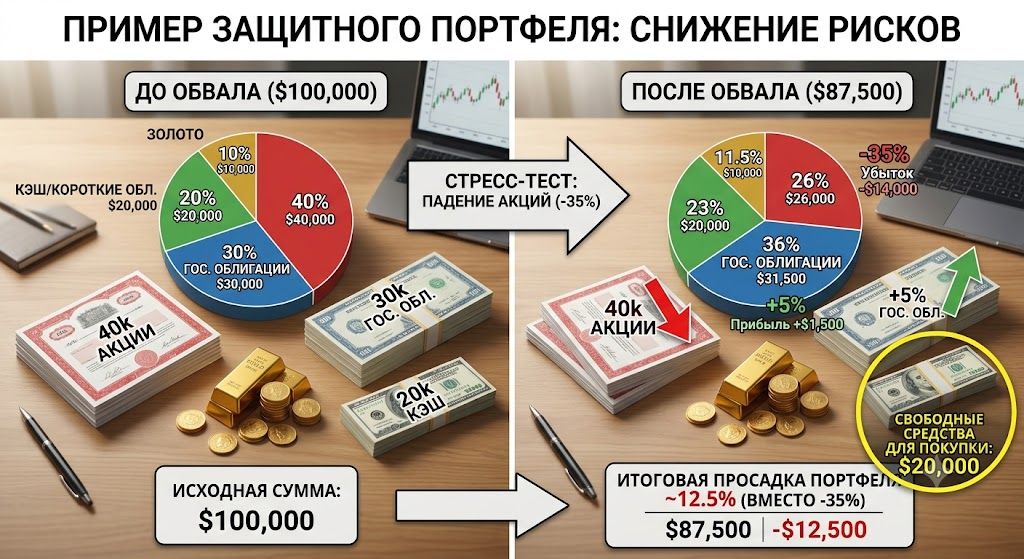
At the same time, the investor will have $20,000 of free funds left to purchase cheaper assets.
Should I sell all my shares?
I wouldn't completely exit the stock market. Recessions are usually announced late, so stocks tend to recover before the economy does.
During the 2008-2009 crisis, the market bottomed in March 2009, even though the recession didn't end until June. Investors expecting good economic news missed the start of the recovery.
Therefore, my strategy is to partially lock in profits on the most expensive and risky positions now, increase my share of safe bonds, and accumulate excess cash. During a recession, this capital can be used to purchase high-quality stocks at significantly more attractive prices. Brokers for stock trading.
The main task is not to guess the exact date of the crisis, but to meet it without debt, with a cash reserve and a pre-prepared action plan.