Doji candles.
Doji are one of the most well-known combinations, whether it's because of their name, their frequent appearance on currency pair charts, or perhaps their appearance and variety.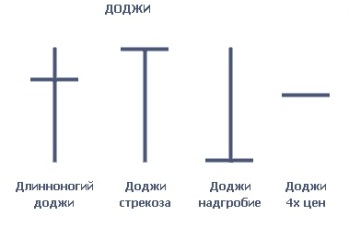 Doji are chart patterns that are almost completely lacking a body, which is their distinctive feature. The lack of a body means that the closing price is almost identical to the opening price, meaning the price has remained virtually unchanged over this period.
There are quite a few Doji variations, the main difference being the length of the shadow and its relationship to the current trend.
A long-legged Doji has a lower shadow that significantly exceeds the upper shadow, indicating greater bearish activity and attempts to push the current price down.
A dragonfly Doji has no upper shadow, indicating weak buying activity in the current timeframe, but despite this, the price has still returned to its opening level.
A gravestone candlestick with a long upper shadow and no lower shadow indicates bulls are attempting to push the price up, albeit only temporarily. It is a good buy signal if the price is near a support level.
A four-price Doji is a unique candlestick variation in which the low and high almost coincide with the opening and closing prices. This means the candlestick has a small body and no shadows. This variation indicates a flat market in the Forex market, with quotes remaining virtually unchanged.
There are quite a few Doji candlesticks, so we'll cover some of them in future articles. Other names for these candlesticks may also exist.
Dojis characterize the market situation as indecisive, therefore they are a warning signal, upon receipt of which one should re-analyze the market situation or postpone the transaction altogether.