Peter Brandt: Biography of a Trader, Strategy, and Risk Management
Today, there are a lot of theoretical traders on the Internet who confidently discuss the market and make forecasts.

But finding people with many years of real trading results is much more difficult.
An example of a successful practitioner is Peter Brandt , an American trader who built a career on trading his own capital.
His approach is interesting for its simplicity: clear graphical models, small risks and strict adherence to rules.
Brief biography
Peter Brandt entered the commodities market in 1976, starting at ContiCommodity Services. In 1980, he founded Factor Trading, where he traded his own funds and provided market research for large clients.
His experience was also included in Jack Schwager's book, "The Mysterious Market Wizards," dedicated to successful stock market participants.
Peter Brandt's Trading Strategy
His approach is based on classical graphical analysis. Brandt searches for price patterns on charts and uses them to determine entry points and exit conditions.
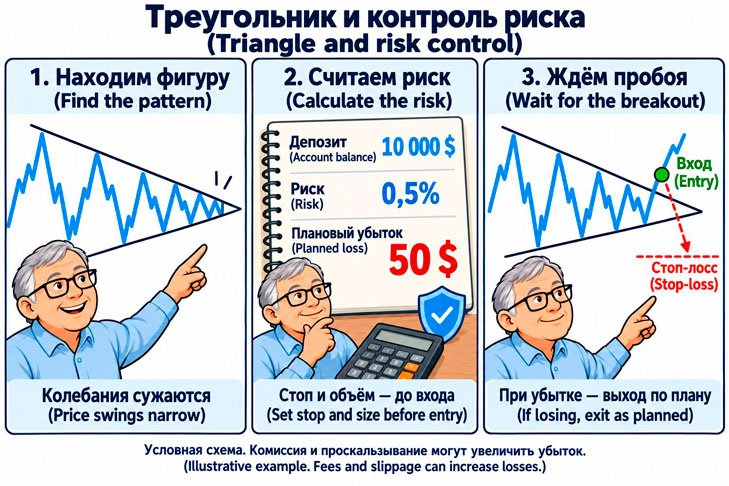
For example, the completion of a triangle and the price moving beyond its boundary may be grounds for opening a position. But the pattern itself doesn't decide everything: you need to determine in advance how much money you can lose if the movement goes in the opposite direction.
Brandt openly admitsthat he's wrong more often than he's right. Therefore, an isolated losing trade is perfectly acceptable to him, as long as it's opened and closed according to the rules.
He pays special attention to the size of the risk. In one of his publications for beginners, Brandt recommended risking no more than 0.3–0.5% of capital per trade. With a deposit of $10,000, this amounts to $30–50.
A hypothetical example of a transaction
Let's assume EUR/USD has been moving in a range for some time, with the upper limit at 1.1000. After a breakout, we consider buying at 1.1010, with a stop-loss at 1.0990 and a target of 1.1070.
The distance to the stop is 20 pips, and to the target, 60 pips. With a deposit of $10,000 and a selected risk of 0.5%, the acceptable planned loss is $50.
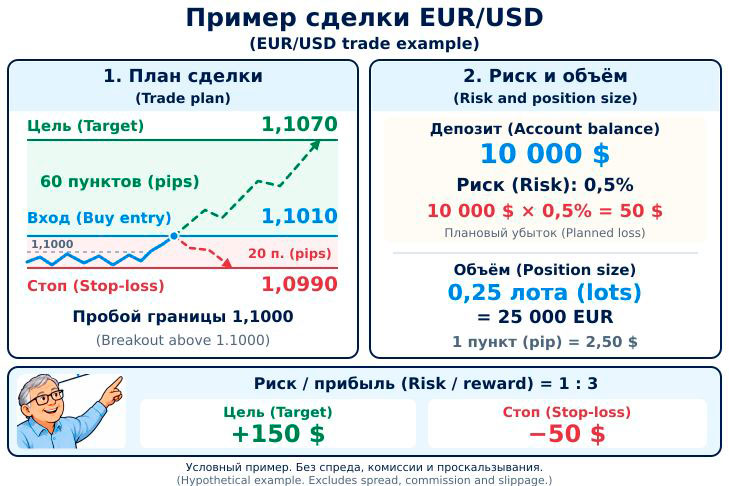
For this stop, the position size will be 0.25 standard EUR/USD lots, or 25,000 euros. If the target is reached, the profit will be $150; if the stop is executed at the specified price, the loss will be $50. The calculation does not include spread, commission, or slippage.
That is, the potential profit is three times greater than the planned risk. The trade may turn out to be unprofitable, but its consequences are calculated before entry.
What you can take from Peter Brandt
Several useful rules can be identified from Brandt's approach:
- First, calculate the risk. Choose the trade size based on the stop loss and acceptable loss.
- Wait for a clear signal. The desire to make money today is not, in itself, a reason to open a position.
- Accept small losses. If the exit conditions are met, close the trade as planned, rather than increasing the loss with false hopes.
- Evaluate a series of trades. Keep a journal and see how your chosen approach performs over time.
In my opinion, the most important thing to learn from Peter Brandt is to anticipate the consequences of your decisions. A good entry point is important, but even a good forecast will be of little use if one bad trade can wipe out a large portion of your deposit.