The spread size for company shares at different brokers
If you prefer to day trade company shares or even scalp, then the most convenient trading option is contracts for difference.
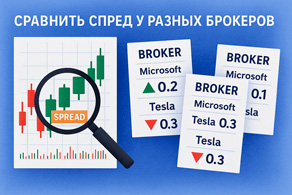
That being said, one of the most important parameters to pay attention to if you are making a large number of trades will be the fee for opening orders.
This fee can be charged as a commission or spread, calculated in dollars or pips. It all depends on the brokerage company you use to trade.
To find a more profitable option, you need to compare the commission amount that you will have to pay for opening a transaction on the stock exchange.
To make the comparison objective, we will try to convert the board size to the same unit of measurement.
Compare broker spreads on stocks
| Broker | Spread type | Minimum spread | Average spread | Comment |
|---|---|---|---|---|
| Alpari | Floating | from 0 points | 15 points | May expand during high volatility |
| RoboMarkets | Floating | from 1 point | 12 points | Suitable for most strategies |
| Amarkets | Floating | from 1 point | 15 points | Stable conditions on standard accounts |
| InstaForex | Fixed | from 2 points | Depends on the asset | Suitable for stable trading without surprises |
If the spread size of 1 pip doesn't mean anything to you, then since the stock quote has two decimal places, 1 pip is equal to 1 cent.
So, if you want to buy shares of a company like IBM Corporation at the current price of $238 and a 2-point environment, you'll have to pay 2 cents to open the trade, which, you'll agree, isn't much.
This size is quite suitable for scalping with leverage; even if you open several dozen trades a day, the fee for opening them will not be significant.

If you want to roll your stock trade over to the next day, you'll also need to pay a swap fee. The swap fee isn't high either, averaging 3-4 percent per annum or 0.001% per day.
In the case of IBM Corporation mentioned above, the swap position rollover fee would be approximately $0.02 per day or $7 per year.