The war in Ukraine will last another three years: how will this affect the markets?
Negotiations between Ukraine and Russia have been ongoing for over four years. Despite regular meetings, discussions, and statements broadcast to the media, there has been no concrete progress toward peace.
The parties do not put forward agreed conditions for ending hostilities, and international efforts often turn out to be formal.
This situation allows experts to conclude that the conflict will not end in the coming months, but may drag on for years.
The Wall Street Journal, citing unnamed European officials, reports that the war "will likely last another one to three years" before a lasting cessation of hostilities or a peace agreement is reached.
What should investors expect in the current situation?
Long-term forecast for the next three years for stock markets, currencies and gold
| Assets | Current level (02/20/2026) | 2027 (forecast) | Change | 2028 (forecast) | Change |
|---|---|---|---|---|---|
| S&P 500 (USA) | 6 909 | 7 800–8 200 | +12,9%…+18,7% | 8 200–8 500 | +18,7%…+23,0% |
| STOXX Europe 600 (Europe) | 630 | 680–720 | +7,9%…+14,3% | 720–760 | +14,3%…+20,6% |
| WIG20 (Poland) | 3 384 | 3 700–4 000 | +9,3%…+18,2% | 4 000–4 300 | +18,2%…+27,1% |
| Gold (XAU/USD) | 5 104 $ | 6 000–6 500 $ | +17,5%…+27,3% | 6 500–7 000 $ | +27,3%…+37,1% |
| EUR/USD | 1,177 | ~1,22 | +3,7% | 1,23–1,25 | +4,5%…+6,2% |
| USD/PLN | 3,5898 | 3,40–3,50 | −5,3%…−2,5% | 3,30–3,60 | −8,0%…+0,3% |
| EUR/PLN | 4,2241 | ~4,25 | +0,6% | 4,10–4,35 | −2,9%…+3,0% |
US stock market
- The US market remains the most resilient. At 6,909 points, the index already factors in strong corporate earnings and expectations of Fed easing.
- If the war persists but does not escalate into a global escalation, the S&P 500 could reach the 7,800–8,200 range by 2027. This represents growth of +12.9% to +18.7%.
- By 2028, with stable company profits, the range of 8,200–8,500 points means +18.7%…+23.0% from the current level.
This is not a bubble phase, but a phase of slow growth with periodic corrections of 10-15%.
European stock market
- The STOXX Europe 600 remains at a geopolitical discount at around 630 points.
- If defense spending and the industrial sector continue to grow, a range of 680–720 points is possible by 2027. This represents +7.9% to +14.3%.
- By 2028, the range of 720–760 points corresponds to +14.3%…+20.6%.
Europe will grow more slowly than the US, but the cheapness of multiples limits the depth of declines.
Poland stock market
- The WIG20 at 3,384 points is more risk sensitive.
- By 2027, the range of 3,700–4,000 means +9.3%…+18.2%.
- By 2028, 4,000–4,300 is +18.2%…+27.1%.
Poland has the potential to show better returns, but with greater volatility.
Investment gold
- At $5,104 currently, gold already reflects a high level of risk.
- If the conflict persists, by 2027 the $6,000–$6,500 range means +17.5%…+27.3%.
- By 2028, $6,500–$7,000 is +27.3%…+37.1%.
Gold remains the main beneficiary of the prolonged instability.
Currencies
- EUR/USD at 1.177 could rise to 1.22 in 2027 (+3.7%) and to 1.23–1.25 in 2028 (+4.5%…+6.2%) if the Fed eases policy faster than the ECB.
- USD/PLN at 3.5898 may fall to 3.40–3.50 in 2027 (−5.3%…−2.5%).
- EUR/PLN at 4.2241 is likely to remain in the range of 4.10–4.35 (-2.9%…+3.0%) by 2028.
The baseline scenario does not foresee a currency panic.
In conclusion, it can be said that any stability, even a stable war, is still stability and market trends remain.
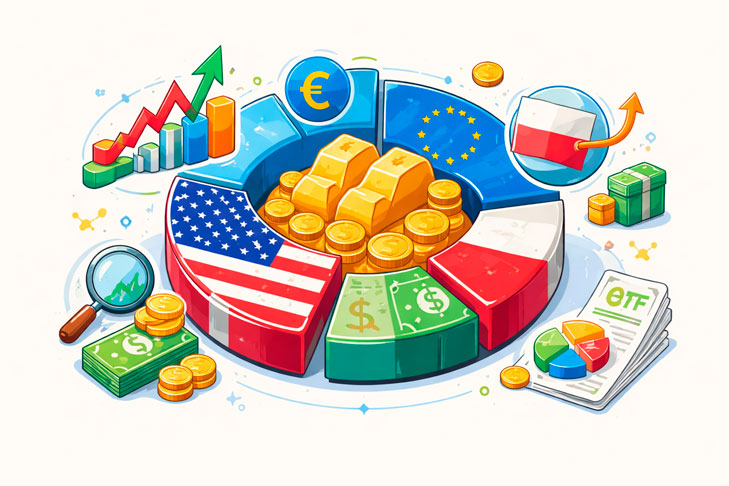
If the conflict does indeed last until 2028, the strategy should be based not on the expectation of a quick peace, but on risk management. It would be wise to base the portfolio on US stocks, with additional exposure to European and Polish stocks, given their volatility.
Gold remains an essential part of the structure as a hedge against geopolitical risks. In the coming years, diversification and discipline, rather than aggressive betting, will be the winning strategy.