Is there a correlation between Bitcoin and gold, and how realistic is it to make money from this relationship?
Trading using correlation, due to its simplicity, has long been a favorite strategy of many traders.

There's nothing easier than selecting assets with a stable correlation, determining whether that relationship is direct or inverse, and then catching the moments when the price of one of the pairs begins to change sharply.
Currently, the most interesting asset for this strategy is Bitcoin, since, unlike traditional exchange-traded assets, it can be traded on weekends.
That is, if there is a correlation between it and, for example, gold, then in practice this property can be applied in the following way.
It only remains to be seen what correlation exists between Bitcoin and gold, and whether it exists at all.
Let's start by analyzing the current situation on the 4-hour chart of XAUUSD and BTCUSD (gold/dollar and bitcoin/dollar):
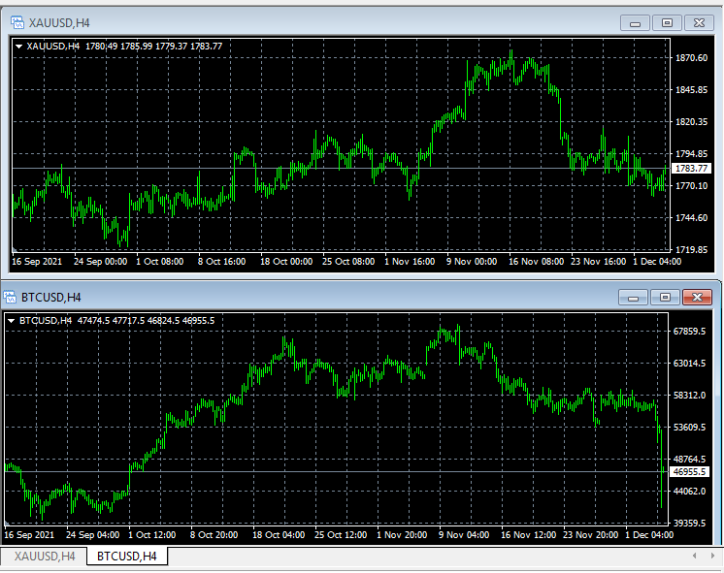
Looking at the charts, we can see that there has been a direct correlation between gold and Bitcoin over the past two months. That is, if Bitcoin rises, so does gold, and vice versa, if gold falls, so does Bitcoin.
But not everything is so clear-cut here. For example, let's take another time period on the same time frame:
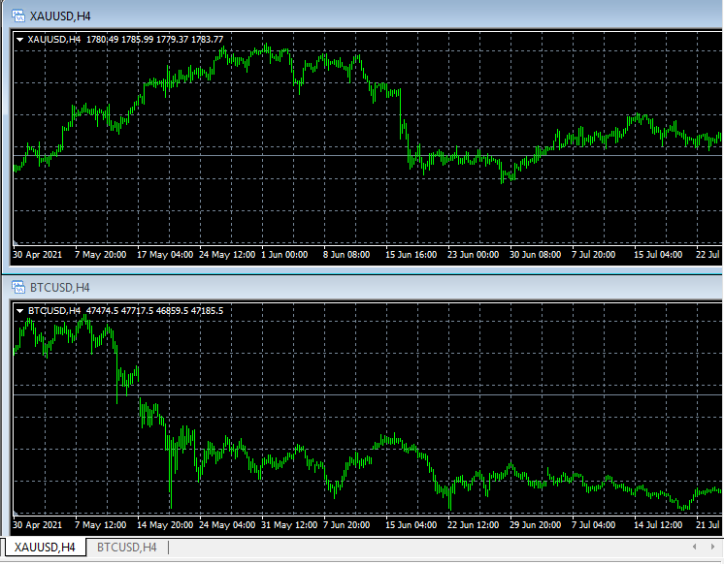
This time, the situation is completely opposite, and we can already talk about an inverse correlation between the XAUUSD and BTCUSD pairs.
If we analyze the situation as a whole, we can say that in most cases there is a direct correlation between gold and Bitcoin.
Experts express a similar opinion, citing a correlation coefficient of +0.7, which is quite high. This means that in most cases, gold will follow Bitcoin.
And if Bitcoin crashes over the weekend, there's a high probability that the price of gold will also crash on Monday.
This pattern can be used to build a simple and quite effective trading strategy, as assets with such properties are rare. However, it's important to remember that other scenarios are possible, and the correlation isn't 100%.