Stock splits on the stock exchange and how stock prices react to them
If you've analyzed the stock prices of leading companies, you've probably wondered why there was a sharp drop in the value of securities at a certain point in time?

However, no one reported the company's collapse, even though its share price had fallen several times. This was all due to a stock split, or, as this process is also known, a securities split.
A stock split (or stock split) is a process in which a company divides its existing shares into several new shares, while the company's overall market value remains unchanged.
This is a popular practice in stock markets used by companies to make their shares more accessible to a wider range of investors.
How does a stock split work?
When a company announces a stock split, it may divide one share into two or more new shares. Dividing one share into two new shares is called a 2-for-1 split, meaning each existing share becomes two new shares.
As a result, investors hold twice as many shares, but the value of each one decreases proportionally. However, the total value of their portfolio remains the same.

Example: Let's say you owned one share of a company's stock, which is worth $100. After a 2:1 split, you'll now own two shares, each worth $50. This leaves your total stock value at $100.
Reasons for a stock split
Companies split their stock for a variety of reasons. The main ones include:
Share Price Decrease: When the price of a single share becomes too high, it can discourage new investors. A stock split lowers the price, making it more attractive to buy.
Increased Liquidity: A stock price reduction due to a stock split can attract more market participants. This increases trading activity and liquidity.
Attracting Small Investors: Highly priced stocks may be inaccessible to small investors. A stock split makes shares more accessible to people with less capital to invest.
Types of stock splits
A regular split: For example, 2:1, 3:1, or even 10:1. In a 3:1 split, a shareholder receives three new shares for every old one. Thus, the total number of shares increases threefold.
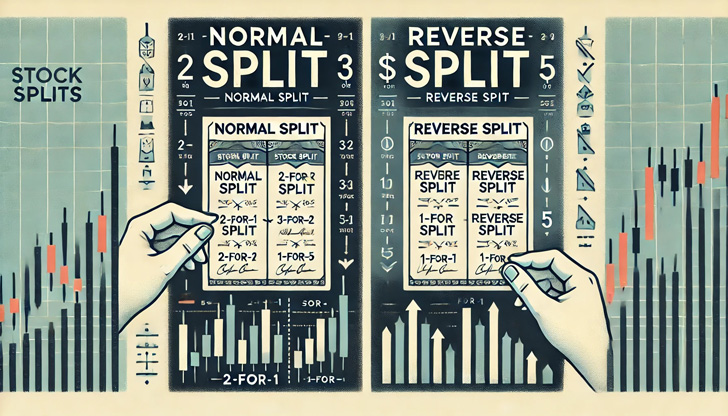
Reverse split: This is the opposite of a regular split, where several shares are combined into one. This is done to increase the share price, especially if it is too low. A reverse split can be done in a ratio, for example, 1:5, meaning that every five shares are combined into one.
Examples of famous stock splits
Apple: One of the most famous stock splits took place in 2020, when Apple split its shares 4:1. This lowered the price per share, making it attractive to investors.
Tesla: In 2022, Tesla also conducted a 3:1 split, reducing the price of its shares by a third.
Typically, after a stock split, the price of the underlying asset begins to rise, driven by psychological factors. Investors remember that one share used to cost $1,000, but now it's only $200, so they buy the security.
A stock split is a useful tool companies use to manage their shareholder base and maintain market appeal. While it doesn't change the company's overall market value, it makes the shares more accessible and liquid, which can positively impact trading activity and attract new investors.