Currency Types: From Fiat to Crypto
Almost every adult is familiar with the term "currency." Every time we travel abroad, make international purchases, or transfer money between countries, we encounter currency exchange.
For example, tourists traveling to another country exchange their native money for local currency to pay for goods and services.
In the world of finance, currencies play a key role, allowing the exchange of goods and services around the world.
However, few people consider that currencies can not only be exchanged for personal needs, but also that one can earn money on the difference in their rates.
This is made possible by the international over-the-counter currency market – Forex.
Unlike standard currency exchange at a bank, Forex trading allows you to earn income from exchange rate changes in real time (24/5) using various currencies: all you need is a computer or smartphone with internet access.
Today we'll introduce you to currencies in more detail, covering their various types, features, and advantages. We'll also discuss where and how to trade various currencies. The international STP/NDD broker NPBFX (NEFTEPROMBANKFX) is our information partner for this article.
A brief history of currencies
Let's begin with a brief historical overview. Currency, as a medium of exchange, emerged long before the modern money we use today. In ancient times, people exchanged goods and services directly—this was called barter. However, barter had its drawbacks, such as the difficulty in determining the equivalent value of different goods and the need for the needs of the parties to the exchange to coincide.
The first prototypes of currencies emerged when people began using commodities that were universally accepted and had a stable value, such as grain, shells, and cattle. Over time, gold and silver became the primary means of exchange due to their scarcity, durability, and divisibility.
A true revolution in the history of currencies occurred with the invention of coins, and then paper money. The first coins were minted in the Lydian Kingdom (modern-day Turkey) around 600 BC. Over time, monetary systems became more complex, with the emergence of national currencies backed by a gold standard, and then fiat currencies, which were not directly backed by precious metals.
Today, currencies exist in a variety of forms, from traditional fiat money to digital currencies such as cryptocurrencies. Each of these forms has its own characteristics and plays a role in the global economy.
Types of currencies
#1. Fiat currencies
Fiat currency is money that has no intrinsic value but is recognized as legal tender by the government. Its value is based solely on trust in the government and the country's economic stability. Examples of fiat currencies include the US dollar (USD), euro (EUR), ruble (RUB), and yen (JPY).
Advantages:
- Widely accepted and used in most countries of the world.
- They are supported by the state and central banks, which ensures their stability.
- Easy to use in everyday life for shopping, paying for services and saving.
Flaws:
- Subject to inflation, which can reduce purchasing power over time.
- In the event of an economic crisis, they can depreciate sharply.
- Controlled by governments, which can impose restrictions on use.
#2. Cryptocurrencies
Cryptocurrencies are digital or virtual currencies that use cryptography to secure transactions and create new units. They are decentralized and operate on blockchain technology. Examples of cryptocurrencies include Bitcoin (BTC), Ethereum (ETH), and Litecoin (LTC).
Advantages:
- Decentralization is the absence of a central authority that controls emission and management.
- Anonymity and high level of confidentiality.
- Global access and the ability to conduct international transactions with low fees.
Flaws:
- High volatility, which can lead to both big profits and big losses.
- Limited acceptance as a means of payment.
- Lack of legal regulation and risk of use for illegal purposes.
#3. Electronic money
Electronic money is funds stored in electronic systems used to make online payments. This can be either fiat money converted into digital form or funds stored in electronic wallets. Examples: PayPal, Yandex.Money, QIWI.

Advantages:
- Ease of use for online shopping and payments.
- High transaction speed.
- Widespread adoption by online stores and services.
Flaws:
- Dependence on technology and internet connection.
- Potential risks of cyberattacks and fraud.
- Fees for transfers and withdrawals.
#4. Commodity money
Commodity money is physical goods used as currency. In ancient times, such goods included gold, silver, shells, and later, gold and silver in coin form. Today, commodity money in its classic form is practically never used, but gold and silver remain important assets, as mentioned above.
Advantages:
- High intrinsic value, especially in precious metals.
- Resistance to inflation and the ability to serve as a reliable store of value.
Flaws:
- Difficulty in use for everyday transactions.
- Limited ability to fragment and divisibility.
- Risk of physical damage or loss.
Local currencies
Local currencies are currencies accepted only within a specific geographic area or community. They are typically used as a complement to national currencies to support the local economy. Examples include the Bristol pound in the UK and the Bavarian thaler in Germany.
Advantages:
- Supporting the local economy and small businesses.
- Reducing dependence on the national currency.
- Strengthening the local community.
Flaws:
- Limited scope of use.
- Low liquidity and difficulty in exchanging for national currencies.
- Risks in case of depreciation or termination of existence.
Currencies in trading on financial markets
Currency trading on financial markets has become extremely popular due to its accessibility and potential for profit. One of the main factors attracting traders is the high liquidity of the Forex market, which is the largest financial market in the world with a daily turnover of over $6 trillion.
Currency trading allows traders to speculate on exchange rate movements using various strategies, such as short-term trades (scalping), long-term investments, and automated trading. Currencies are also often used as a hedge against risks in international trade.
Popular trading instruments include:
- Currency pairs (e.g. EUR/USD, GBP/JPY)
- Cryptocurrency pairs (e.g. BTC/USD, ETH/EUR)
- Metals (eg gold, silver) as instruments of trade.
Modern brokerage firms, which act as intermediaries between the financial market and retail traders, offer leverage when trading various currencies. This allows traders to trade with amounts significantly greater than their own funds. For example, with leverage of 1:1000, a trader with $1,000 can trade $1 million.
Essentially, the brokerage company finances your trading. However, it's important to understand that both profit and loss will be proportional to this amount. Therefore, strict risk management is crucial.
Let's look at a clear example of such a currency transaction. Please see the chart below:
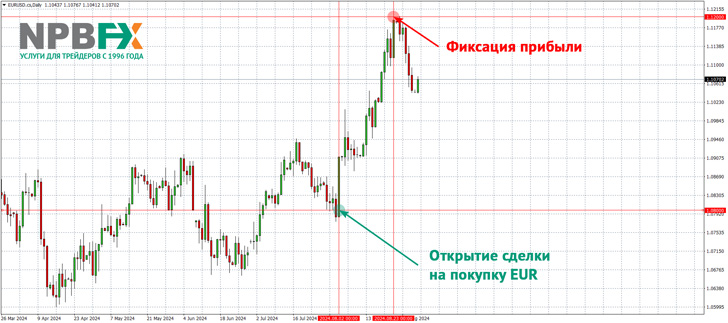
A trader using 1:1000 leverage opened a Buy EURUSD trade for 1 standard lot at 1.0800. In simple terms, they bought 100,000 euros. Twenty-one days later, the trader sold the euro at a rate of 1.12 US dollars per 1 euro. The profit during this period was $4,000.
Conclusion
Currency trading offers unique opportunities, but it also requires knowledge and experience. It's important to choose a reliable broker for trading and learning how to trade.
NPBFX is a leading broker offering favorable conditions for Forex trading across five markets: fiat currencies, cryptocurrencies, precious metals, stocks and indices, and commodities. Among the broker's advantages:
- High reliability – on the market since 1996, 20 years of banking experience.
- Access to the interbank market using STP/NDD technology, eliminating conflicts of interest.
- Tier 1 liquidity providers (major global banks and ECN systems).
- The modern Metatrader 4 trading platform, including a mobile application and a web terminal.
- Professional analytics and customer support in 8 languages.
- The Financial Commission's highest Category A rating allows traders to receive a payout of up to €20,000 in the event of a dispute with a broker.
- We serve traders from the Russian Federation with over 20 deposit/withdrawal methods.

We recommend you start trading with NPBFX to take advantage of all the benefits of working with a professional brokerage company. Register and open an account now – take the first step toward successful trading in the financial markets!