Copper and the Chilean Peso Correlation: An Investment in the Future
The Forex market is considered one of the most unpredictable, as exchange rates can be influenced by a variety of factors, ranging from domestic monetary policy to various external factors.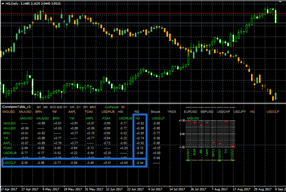
Such unpredictability is primarily observed in the largest global currencies such as the dollar, euro and pound.
At the same time, easily predictable exotic instruments lie practically on the surface, where either an industry or commodity relationship can be traced.
The Chilean peso has one of the most pronounced correlations between metal prices and the national currency exchange rate, and in this article, you will learn how to use this correlation to your advantage.
Copper and Pesso: Reasons for Growth
Copper is not considered a precious metal like gold and silver, but despite this, its price has been rising for several years.
In an era when major automotive companies have begun to shift their focus to electric vehicles, copper is becoming a highly sought-after metal.
And if electric cars are now extremely rare within the city limits, imagine how much the demand for ore will increase once these vehicles become widely available.
Copper, in one way or another, is involved in all sectors of the economy, from construction and mechanical engineering to electronics, transport and all sorts of other industries where mechanization is present in one way or another.
As an example, we suggest looking at the structure of copper consumption in the world and its importance in various industries.
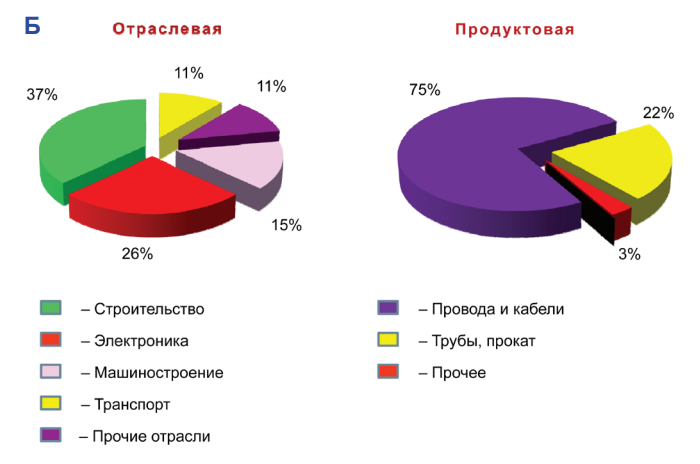
Given the fact that scientific progress does not stand still, and all areas of industry are gradually being robotized, the demand for copper will grow annually.
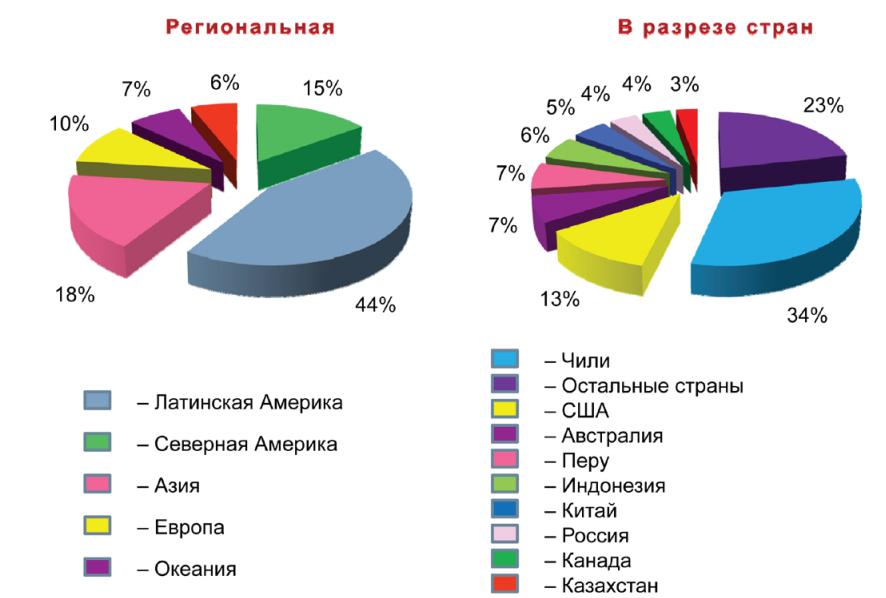
Now let's take a look at the structure of oil production by country, which you can see below:
From the chart above, you can see that Chile is the largest leader in copper ore mining, as well as copper processing and sales.
Just imagine that one-third of all copper is mined and sold by this strange country. Therefore, the basis for the exchange rate stability of this country, namely the peso, is global copper prices.
The Correlation of Copper and the Chilean Peso: How to Profit From It
As already noted, Chile is the world's largest copper exporter, holding a third of the world's reserves and leading the metals market.
The share of profits going to the state budget is very high, so there's a direct correlation between the Chilean peso and copper. As an example, consider the copper price chart for the past year:
Now, for comparison, let's look at the chart of the USDCLP (Dollar/Chilean Peso) currency pair.
It's important to understand that this quote is inverse and reflects the price of one dollar per peso, not the other way around. Therefore, a decline in the chart should only be interpreted as a strengthening of the Chilean peso.
In order to check the correlation not visually, but actually technically, we used the auxiliary indicator I Correlation Table (ftp/indikator/iCorrelationTable_v3.rar), which shows us the inverse or direct correlation, which is in the range from -1 to +1.
The results of the study are shown below:
As you can see, not only is there a visual inverse correlation between the instruments, but the I Correlation Table indicator also records a very high coefficient, which is -0.94.
This indicates a direct correlation between the assets. In practice, this allows traders to employ a guide-the-horse strategy: if copper begins to rise, then the Chilean peso should be expected to strengthen, and vice versa.
In conclusion, I'd like to point out that investing in copper and the Chilean peso is an investment in the future. Thanks to the high correlation between these instruments, you can create arbitrage opportunities strategies and earn with the lowest possible risk.