Yuan's outlook based on economic growth.
China's economy has been growing rapidly in recent decades, and is in fact one of the most dynamic economies in the world.
It is true that since 2011 there has been a slowdown in economic development, and the global crisis has reached China.
It’s not that the slowdown is critical, but still, compared to other years – in 2010 – 10.4%, 2011 – 9.4%, 2012 – 7.8%, 2013 – 7.7%, 2014 – 7.4, 2016 – 6.7%, as you can see, the trend is obvious.
Analysts' forecasts for 2017 are being fully confirmed; according to preliminary data, China's economic growth this year will be in the region of 6.2-6.5%.
There are many reasons for this decline, the most significant of which is the decline in exports of Chinese goods to foreign markets.
How does the economic slowdown affect the Chinese currency exchange rate?
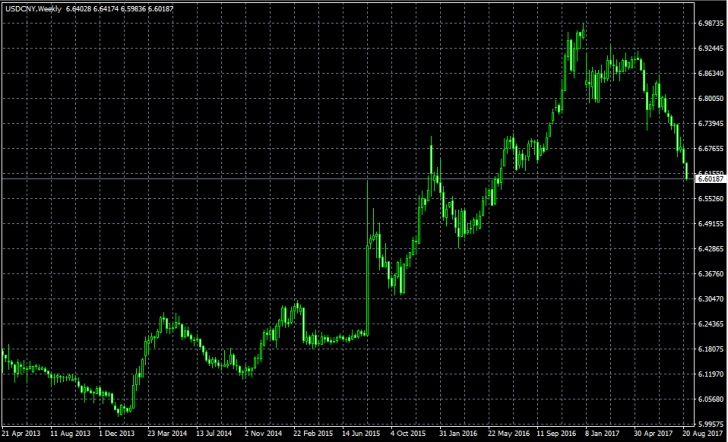
Why is the yuan rising?
It turns out it's not the yuan that's rising, but the dollar that's falling against other currencies. For example, the euro is strengthening against the yuan, and in three months, the euro has appreciated against the yuan by more than 4%.
That is, the yuan is falling, but not as rapidly as the dollar; the reduction in exports is still reflected in the exchange rate of the national currency.
At this stage, investments in yuan, as well as in shares of Chinese companies, are losing their attractiveness.