How did markets react to the US credit rating downgrade?
On May 16, 2025, Moody's rating agency downgraded the US credit rating from its highest level, Aaa, to Aa1.
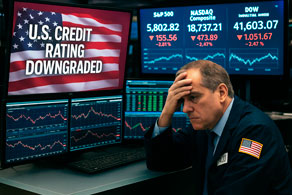
The decision was another wake-up call for financial markets following similar actions by Fitch in 2023 and Standard & Poor's in 2011.
Thus, for the first time in the last hundred years, the world's largest economy simultaneously lost its top rating from all three leading rating agencies.
The main reasons cited for this decision were growing budget deficits, the high cost of servicing the national debt, and the lack of clear steps by the US government to stabilize financial policy.
The market reaction to this event was immediate, but moderate compared to historical experience. In the first days after the announcement, the yield on 30-year US Treasury bonds rose sharply, exceeding 5% for the first time since 2023. But the number of people willing to buy them dropped to virtually zero.
The US dollar has lost around 2.3% over this period, demonstrating the caution of investors who prefer to reduce risks.
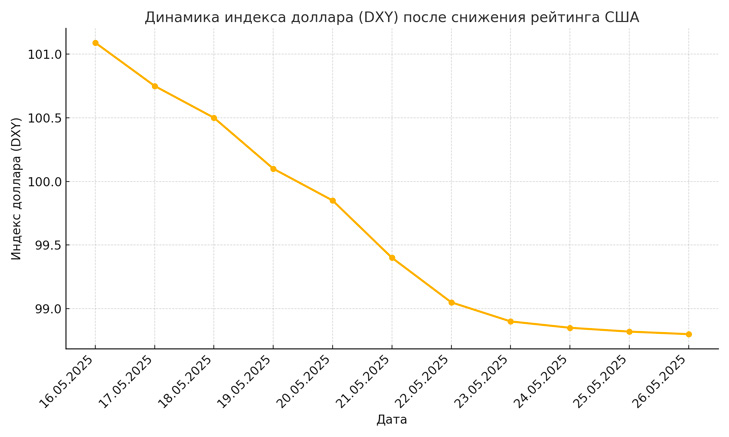
Against the backdrop of the rating downgrade, investors are massively transferring funds from the dollar to more secure assets.
Gold, a traditional safe haven, has risen 7% since then, confirming growing expectations of further volatility.
Stock markets reacted mixed:
- S&P 500: fell from 5,958.38 to 5,802.82, a loss of 155.56 points or -2.61%.
- NASDAQ Composite: fell from 19,211.10 to 18,737.21, a decline of 473.89 points or -2.47%.
- Dow Jones Industrial Average: fell from 42,654.74 to 41,603.07, a loss of 1,051.67 points or -2.47%.
Shares of large financial companies, particularly banks and insurers, came under brief pressure but quickly stabilized amid subdued statements from the Federal Reserve.
To better understand the current outlook for markets, it's worth looking back at the historical experience of a similar downgrade in August 2011, when Standard & Poor's downgraded the US to AA+ for the first time.

The market reaction was much more dramatic back then: the Dow Jones index fell 5.5% in a single trading day, the biggest single-day drop since the 2008 crisis.
Gold hit a historic high during this period, and US Treasuries, contrary to expectations, also attracted significant amounts of capital, highlighting the paradoxical appeal of these instruments even in the face of rating downgrades.
The current situation differs from the events of 2011 in that markets now perceive rating downgrades more calmly, although no less seriously.
Investors' wariness is driven primarily by deep concerns about the US fiscal future.
The national debt has already approached $36 trillion, and the budget deficit continues to steadily increase, which could further worsen the situation in the next decade.
In the near future, the following factors will influence investor behavior:
- Redistribution of capital into safer assets such as gold, silver and government bonds of countries with stable economies (Norway, Switzerland, Singapore).
- The US dollar weakened against safe-haven currencies, the Japanese yen and the Swiss franc.
- The likelihood of increased demand for cryptocurrencies such as Bitcoin, which can act as an alternative to traditional financial instruments in conditions of increased uncertainty.
Thus, the downgrade of the US credit rating is an important signal that indicates the need for close monitoring of macroeconomic indicators and central bank policies.
Despite the relative calm in the short term, the long-term consequences of such a move could have a more profound impact on markets and significantly adjust investment strategies around the world.