Will the price of oil pull the Russian ruble along with it?
A few days ago, on November 18th to be precise, the price of oil began its decline, which continues to this day. 
In just a few days, the price of BRENT crude fell from $63.30 per barrel to $60.70, a decline of more than 4%.
The main reasons for the decline were the failure of trade negotiations between the US and China and the failure of major oil exporters to agree to cut production.
The latter led to an oversupply of crude oil on the energy market, estimated at around 1 million barrels in daily trading.
There is no sign of a break in this situation, so all the preconditions exist for a further decline in the price of BRENT crude below $60 per barrel.
What will happen to the Russian ruble?
It's clear that such rosy prospects cannot help but impact the Russian ruble exchange rate, but surprisingly, the initial news led to some strengthening of the ruble against the US dollar:
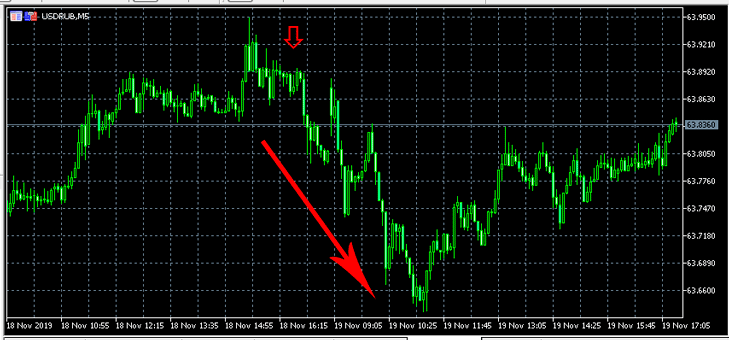
However, this didn't last long. After strengthening to 63.66 rubles per dollar, the Russian ruble began to weaken, now standing at 63.81 rubles per dollar.
Low oil prices are reducing tax revenues for the federal budget, as the average price of Urals crude oil, as budgeted for 2019, is $63.4 per barrel.
Currently, the price of Urals crude oil is $57.77 per barrel, almost 10% below the budgeted average for 2019.
Clearly, this will impact the Russian ruble, which will likely continue to decline to 65 rubles per dollar. And perhaps even lower if oil prices continue to fall.
In this situation, there's a chance to make a small profit by selling the ruble. However, it's important to constantly monitor oil market news to avoid the start of an oil price increase, which is bound to happen sooner or later.