Principles of price formation in the Forex currency market
When starting to trade Forex, many traders completely ignore the theoretical foundations of the currency market, relying solely on indicator signals.

Moreover, they do this completely in vain, because knowledge of the principles of price formation allows you to understand what is currently happening on the exchange and can serve as an excellent filter for false signals when making the right decision.
The essence of the process is that each indicator signal in the trading platform must be based on a specific event.
That is, if the script signals a trend reversal, and there are no strong events in the news feed, you need to think carefully before opening a trade.
The foreign exchange market is called a market for a reason, as it operates under market laws. This means that exchange rates are determined solely by supply and demand.
There are two parties in this process: buyers and sellers. The former want to buy currency, while the latter want to sell it. The ratio of buyers to sellers plays a key role in this process.

If a large number of people enter the market and the supply is limited, the price begins to rise, somewhat reminiscent of an auction. Each purchase is made at a higher price, and the rising price attracts even more buyers.
Once buyers have exhausted their resources and are no longer willing to make purchases at the current, usually inflated, price, the exchange rate begins to decline.
This is where sellers come in, rushing to sell their currency at a high price. The number of sellers on the market increases, and supply exceeds demand.
The principles of price formation are best understood through specific examples; let's take, for example, the recent situation with the Russian ruble:
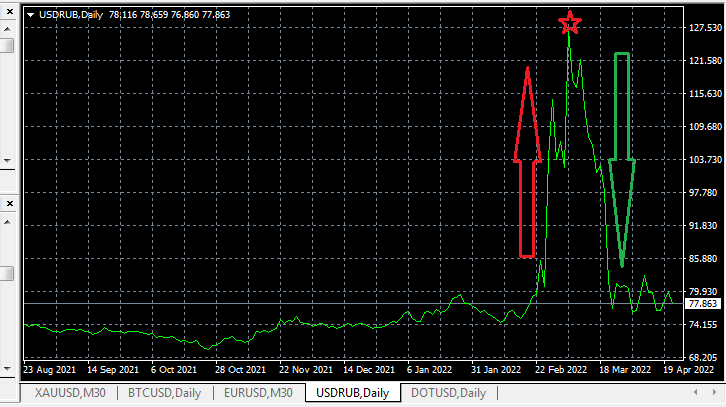
Following news reports of the outbreak of military action in Ukraine, Russians traditionally rushed to exchange rubles for dollars. Increased demand for the US dollar triggered a rise in its exchange rate.
And after the government introduced a ban on cash currency, the price skyrocketed to record highs, as despite the enormous demand, there was no supply.
But gradually, those eager to buy currency at any price satisfied their needs, leading to a decline in demand. At this point, the government reopened the currency market, and the price practically returned to its original levels. This situation clearly demonstrates how supply and demand shape exchange rates.
The exchange rate itself is determined on the interbank market, where banks and brokers attempt to fulfill their clients' currency purchase and sale requests. Requests are submitted electronically, and the rate is determined based on the number of purchase and sale requests.
If the volume of buy orders prevails, the rate rises, and vice versa, if the volume of sell orders is large, the price falls.
Your task is to learn to understand what is currently happening in the currency market and what are the reasons for the changes that are occurring.