Correlation Strategy.
It's no secret that there's a clear correlation between the prices of currencies and other financial assets. Almost every trader knows that when gold rises, the Australian dollar rises. This correlation can be observed almost everywhere; the key is to know how to exploit it correctly.
The Correlation Strategy involves identifying patterns in the price movements of specific currency pairs. Its simplicity and effectiveness are appealing. Using it doesn't require in-depth knowledge of technical analysis; a certain degree of observation is sufficient.
The easiest way to understand the essence of this Forex strategy is through specific trading examples, which can also serve as a model.
Organization of trade using the Correlation strategy.
1. Trading time frame – M30 or longer; the strategy assumes stable trends.
2. Deposit – preferably at least $1,000. The deposit size doesn't affect trading efficiency; it only regulates the amount of profit.
3. Trade volume – since trades will be quite long, when choosing the trade volume, the following rule should be followed: the trade volume should not exceed the account equity by more than 40 times, i.e., use a Forex leverage of 1:40.
4. Currency pair – selected based on the market situation; to do this, simply analyze the movement of currency pairs simultaneously on the same time frame. All charts should have the same scale and display method – bars, candlesticks, or lines.
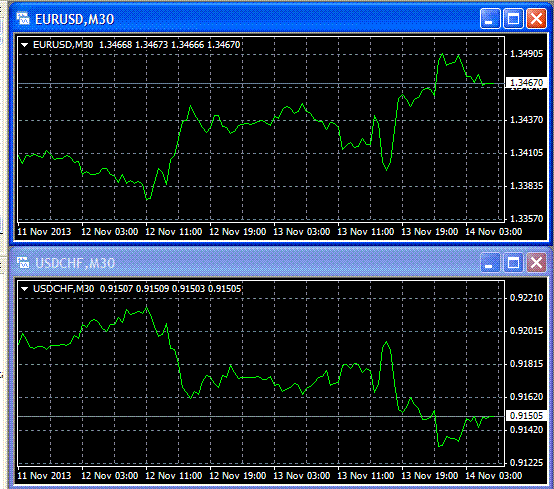
In our case, these pairs were EURUSD and USDCHF, which have an inverse correlation with virtually zero deviation. It would be better to find a pattern in which one pair reacts to an event earlier, while the other with a slight delay. Moreover, there may be more than two pairs.
5. Technical tool for the correlation strategy – this tool is the indicator of the same name, which allows you to display information on five currency pairs simultaneously – download the correlation indicator.
The correlation strategy itself is built on the following scheme.
1. Find several currency pairs, preferably with a certain lag factor for one of them.
2. Monitor the trend movement on the signal currency pairs and, when a new trend emerges, open a trade on the main currency pair (the one that lags).
3. The opposite situation serves as a signal to close the trade.
Correlation instruments can be used not only with currency pairs, but also with gold or silver.
More complex correlation trading options exist, but they all follow a similar principle.