A Financier's Story - Bernard Baruch: Man Against the Crowd
In his works, Bernard Baruch wrote that despite the fact that each individual person may have high intelligence and sound reasoning, when the crowd begins to move, almost everyone, without exception, follows it.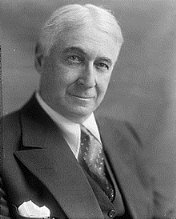
On the stock exchange, the herd instinct manifests itself in all its glory, because a trend is a reflection of the crowd's mood, so to speak, the realization of its expectations.
In his book, Bernard Baruch gave a clear answer to how he achieved success in the stock market: he stopped being part of the crowd. He bought when everyone else was selling and sold when everyone else was buying.
Fear, panic, and herd instincts lead to rash actions, but when everyone was losing en masse, Baruch was making millions.
Early years
The future genius was born in 1870 in Camden, South Carolina. He grew up in a fairly well-off family, as his father was a prominent surgeon at the time who laid the foundations for patient rehabilitation through physical therapy.
Organized crime and the constant murders of black people were not a safe environment for a child to live in, so when Baruch turned 10, the whole family saved up some money and moved to what was then a safer New York City.
Bernard Baruch was a very talented and hard-working child who wanted to make a career as a trader.
After graduating from a local New York college, he immediately went to work for a stock exchange company.
Bernard started from the bottom, being paid just $3 a week to carry out various tasks for banks and the trading floor.
However, the young man was very smart and had a keen interest in the stock exchange, so the company noticed him and made him a trader who executed client orders.
A little later he became a partner in the brokerage firm A. Housman & Co and began to own one-eighth of the shares that he had to buy when he became a partner.
Bernard decided to go it alone in 1898, and with the help of excellent connections he had made while working as a broker, he was able to buy a place on the stock exchange floor.
However, instead of success, he was constantly losing money, losing deposit after deposit.
One day he came to his father for help, who gave him 500 dollars and said that this was the last money he had put aside for a rainy day.
When Baruch came to the trading place, he could not make deals, because it seemed to him that he would lose them back, because he had previously been confident in himself, but still suffered failures.
After a long pause, he began to act, but was already making deals against the crowd and was not wrong.
Unprecedented growth
The last 500 dollars taken from his father began to actively bring Baruch money, and quite a lot of it.
Being an avid speculator, he managed to accumulate quite a solid income, which he wisely invested in the Texasgulf company, becoming its co-founder.
It's worth noting that the company provided equipment and repair services for oil companies, and since oil production was still in its infancy at the time, Baruch went from being an upstart trader to a millionaire in a matter of years.
A little later, in 1903, Bernard and his brother founded their own company, Baruch Brothers. It's worth noting that trust and hedge funds were quite popular at the time, but Baruch was a loner and disliked teamwork.
He handled all trades and securities purchases personally, earning him the nickname "The Lone Wolf." After purchasing Hentz, a major trading company with a vast representative network, Baruch became the undisputed leader in the stock market.
Political ambitions
During the US presidential elections, Baruch supported Woodrow Wilson with his funds, who later made him his advisor and then a member of the committee on purchasing weapons for national defense.
It is worth noting that at the outbreak of the First World War, Baruch owned shares in a huge number of military factories, which enabled him to earn more than 200 million dollars.
Bernard Baruch died on June 20, 1965, at the age of 94. A friend and ally of Churchill himself, Baruch was one of the most influential people in the world. Baruch left behind a fortune of over $1 billion.