Canadian dollar.
The Canadian dollar serves as a means of payment in Canada and is freely exchangeable for the national currencies of most world powers.
Recently, this currency has begun to gain increasing popularity against the backdrop of the unstable US dollar and euro.
Until recently, the Canadian dollar served primarily as a commodity currency, used to settle accounts for oil and metals, of which Canada is the largest exporter.
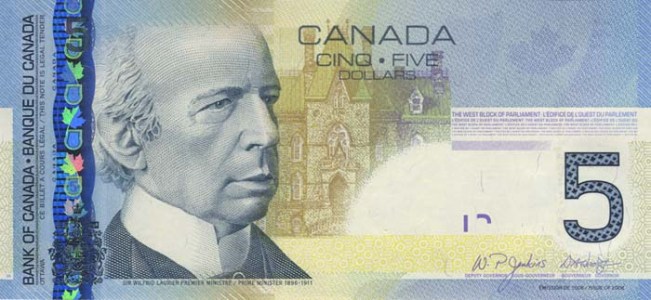
This currency is currently gaining popularity as a stable instrument for building foreign exchange reserves for national and commercial banks. This increased demand is driven by the currency's stability and positive economic outlook.
Citizens of many countries are also beginning to show increased interest in this means of payment, using Canadian currency to protect their savings from depreciation.
In international transactions, the Canadian dollar is still less popular than other world currencies, yielding its position to such currencies as the euro, the US dollar, the Japanese yen, the British pound and the Swiss franc; its share of use in total world trade turnover is only a few percent.
This currency is included in the list of freely convertible world currencies, so the price is determined only through open trading, depending on supply and demand. Currently, its value is almost equal to the US dollar, fluctuating between 1 and 1.01 Canadian dollars per US dollar.
Only five denominations of banknotes are in circulation: 100, 50, 20, 10 and 5 dollars.
Due to its dependence on commodities, the exchange rate of this currency is easy to predict, which is why this currency is in high demand among traders on the Forex market.
Operations involving it are carried out on currency pairs such as CHF/JPY, EUR/CAD, USD/CAD. The last currency pair is the most attractive for trading, since the factors influencing the Canadian dollar exchange rate sometimes have the opposite effect on the US dollar, so the price of the USD/CAD currency pair drops sharply.
The main factors causing the growth of the Canadian dollar exchange rate are the increase in prices for oil and oil products, non-ferrous and ferrous metals, reports of an improving economic situation within the country and the publication of major financial indices.
Tracking them in a timely manner provides excellent prospects for trading using the Forex news strategy.