Accumulator ETFs: What They Are, Their Advantages, Disadvantages, and 10-Year Statistics
An ETF (Exchange-Traded Fund) is a ready-made set of stocks or bonds that can be purchased on the stock exchange as a single security.
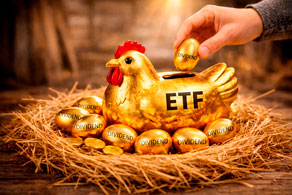
Imagine buying not just one Apple share, but a "basket" containing shares of hundreds of the world's largest companies.
Investors love ETFs for their simplicity—they don't have to pick individual companies themselves; their reliability—if one company in the basket goes bankrupt, the other 499 will lift the fund; and their low cost—management fees for such funds are usually tiny.
This combination makes ETFs an ideal vehicle for long-term investing: diversification, low costs, and convenience.
What are accumulator ETFs?
Typically, companies included in ETFs pay dividends (share their profits). In simple (distributing) funds, this money goes directly into your account. But in accumulator ETFs (often marked "Acc" in the name), the fund doesn't pay you dividends; it uses them to buy new shares.
Your capital “multiplies itself” – dividends are reinvested within the fund, and you see this in the increase in the value of the ETF itself.
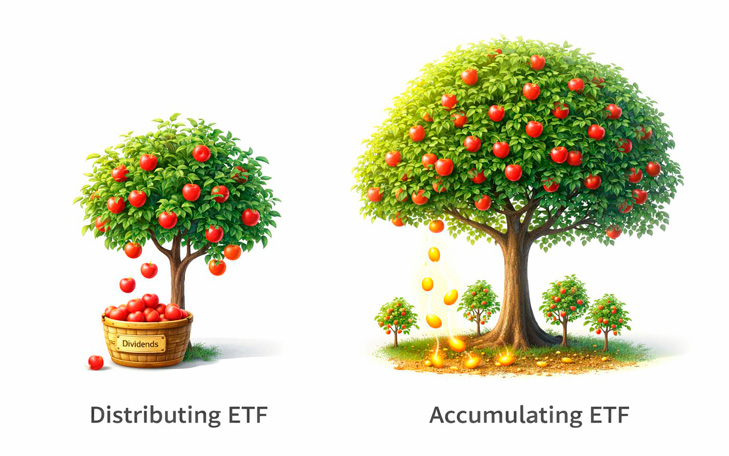
In other words, with accumulative ETFs, the fund doesn't pay you dividends, but rather immediately buys new shares with them. Your capital "self-replicates," so to speak.
Advantages of accumulation ETFs
The main advantage is automatic reinvestment of dividends.
Tax benefit. With a regular fund, you receive dividends and are required to pay taxes on them annually. With an accumulation ETF, taxes typically only arise when the fund is sold. This allows money that would otherwise go to the government to continue working for you for years.
Compound interest in action. Because dividends are reinvested automatically and in full, the total value of your assets grows faster.
Save on commissions. You don't have to manually buy new shares with incoming dividends and pay a brokerage commission each time. The fund does it for you.
Discipline. You're not tempted to spend dividends—they go straight back into investments.
Ease of management. Particularly convenient for long-term savings, when capital growth is more important than current payments.
Disadvantages of accumulation ETFs
There's no "live" money. You don't receive regular payments, which can be a disadvantage for those who value current income.
Psychological factor. You don't see any income coming into your account—only the fund's price rises.
Difficulty assessing income structure. It's not always clear how much growth is due to dividends and how much is due to share price appreciation.
10 Popular Accumulator ETFs and Their 10-Year Performance
Below is a table with examples of well-known accumulation ETFs targeting broad markets and popular indices, with their 10-year growth data
| № | Ticker | Name of the fund | What's inside (index) | 10-Year Growth (Overall) | Avg. year growth |
|---|---|---|---|---|---|
| 1 | SXR8 | iShares Core S&P 500 Acc | 500 largest US companies | +322% | ~15.5% |
| 2 | SXRV | iShares Nasdaq 100 Acc | US tech giants | +580% | ~21.1% |
| 3 | QDVE | iShares S&P 500 Info Tech | IT sector (Apple, Nvidia, Microsoft) | +715% | ~23.5% |
| 4 | SMGB | VanEck Semiconductor Acc | Chip manufacturers | +920% | ~26.2% |
| 5 | IWDA | iShares Core MSCI World Acc | The entire developed world | +195% | ~11.5% |
| 6 | VWRA | Vanguard FTSE All-World Acc | Shares around the world | +188% | ~11.2% |
| 7 | VUSA | Vanguard S&P 500 Acc (GBP) | Top 500 US Companies (in Pounds) | +318% | ~15.4% |
| 8 | MEUD | Lyxor Stoxx Europe 600 Acc | 600 largest companies in Europe | +110% | — |
| 9 | EIMI | iShares MSCI EM IMI Acc | Developing countries | +65% | ~5.1% |
| 10 | CNX1 | iShares MSCI China Acc | China's Largest Companies | +25% | ~2.3% |
Accumulation ETFs are best suited for investors who are focused on long-term capital growth and do not require regular distributions.
If your investment horizon is 10–20 years, the accumulative format allows you to maximize the effect of compound interest and simplify portfolio management. For those who value regular cash flow, distribution ETFs are a better choice.
Brokers for investing and trading ETFs - https://time-forex.com/vsebrokery/brokery-fondowogo-rynka