Why passive income requires much more money than you think
Recently, passive income has become a popular dream; almost everyone plans to save up the necessary amount of money and then live off the interest.
But most people don't realize that their calculations are actually completely wrong and that passive income requires much more money than it seems.
Let's start with what sources of income can be considered passive; in fact, there aren't as many as it might seem at first glance.
In my opinion, the only truly passive income that can be called interest on deposits, coupon payments on bonds, and dividends from shares.
Because these assets provide a stable amount of payments that you can live on.
Why do we need more money than we think?
The answer to this question is quite simple: when investing, you need to consider factors such as inflation, taxes, and risks. But it will be clearer with some specific examples:
Passive income from bank deposits and government bonds
Imagine you deposit $500,000 in a bank at 5% interest per annum, you end up with about $2,100.
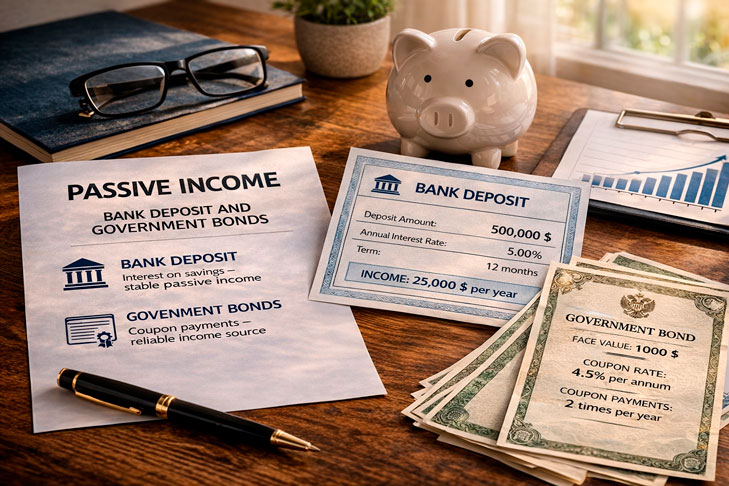
The amount is quite substantial and would be enough to live on in some countries, but this is where things get interesting:
Taxes are at least 15-20% of this amount, every year it becomes more and more difficult not to pay them, and you are left with 2100 - 20% = 1680 dollars
Inflation – the average inflation rate for the US dollar is 3% per annum, meaning the purchasing power of your money will decrease by 30% in 10 years: $1,680 – $630 = $1,050. This amount no longer seems so attractive.
Passive income from stock dividends
Here the situation is even more complex and interesting: you can’t buy shares of one company with high dividends and receive a stable interest rate for 10 years.

There are risks that the company may reduce the size of dividends, stop paying them, or even go bankrupt.
Therefore, it's common to hedge stock risks by purchasing bonds, gold, and diversifying. This means that creating a stable and secure income requires an even larger sum.
Besides this, no one has cancelled inflation and taxes; these two beasts eat up a significant portion of profits.
Therefore, to truly live on passive income, you need many times more money than is estimated in simple calculations.
If desired, you can, of course, begin to gradually spend the principal by withdrawing part of your deposit or selling stocks. In this case, the $500,000 sum would be enough to maintain a stable $2,000 payment, adjusted for taxes and inflation, for approximately 25 years, but after that time, your principal would be worth zero.