How can you lose money on investments when markets are rising?
If you're involved in investing, you've probably encountered warnings that investing is risky and that you might not only fail to make money, but also lose your money.
But how can you lose money by buying something that is constantly getting more expensive?
Take a 10-year chart of almost any asset— a stock index, gold, or real estate prices—and you'll see price increases several-fold.
At the same time, people are constantly losing money on investments and going bankrupt.
Let's try to understand the reasons for losses in investments; perhaps knowing them will help someone avoid potential losses.
The Main Causes of Investment Losses
The timing of purchases and sales is one of the main reasons for losses.
The price of any asset never moves strictly upwards; periods of growth are often followed by periods of decline, and if you bought gold at its peak and sold it during a correction, even an asset like gold can lead to losses.
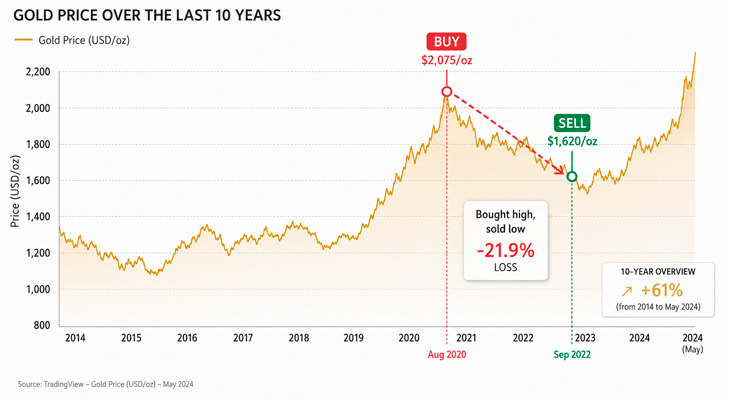
Time plays a crucial role in investing. It all depends on when you need to sell an asset, and if circumstances force you to do so immediately, regardless of the price, this is precisely the case that will lead to losses.
For example, you bought gold in 2020 at $2,000 per ounce , expecting to hold it for at least five years. But a year later, you urgently needed cash and sold it at $1,600. The result was a 20% loss.
If there was no need to sell, then in five years you would have sold your gold for $3,500, with a profit of 75%.
This means that in order to avoid losses, you need to plan your investments so that you don’t have to sell at the most inopportune moment.
Bad Asset - This aspect mainly applies to buying shares of individual companies, if stock indices rise in the long term, then individual stocks may collapse and never rise again.
Let's remember, for example, such a well-known company as Kodak. In 1997, the price of 1 share of this company reached $95, now the share costs $9, that is, a loss of 90%.
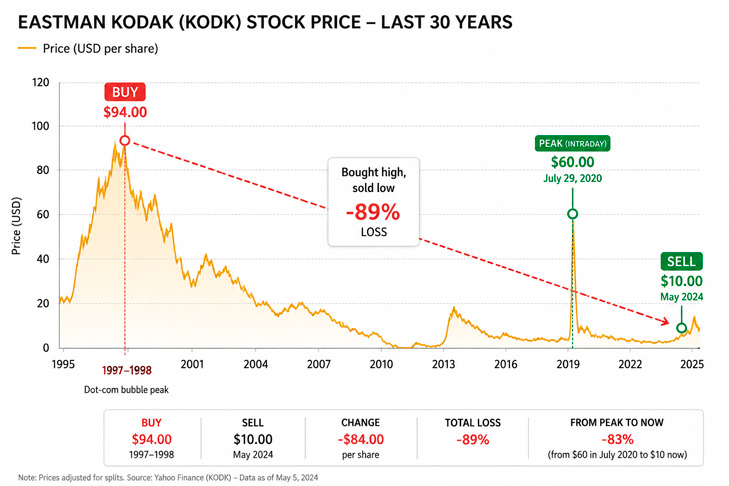
Buying a single security can sometimes yield huge profits, but if a company goes bankrupt, there's a risk of losing everything. Therefore, many investors buy indices, which include multiple securities and are already diversified against risks, rather than individual stocks.
Based on the above, we can conclude that to reduce investment risks, it is advisable not to buy at peaks or with your last money, and also to try to invest more in indices than in individual stocks.