The top five stock indices that have risen the most in a decade
Recently, investing in the stock market has become increasingly popular due to the expansion of the active circle of investors.
Along with regular shares, stock indices are attracting special attention, providing diversification of funds and reducing the risks of individual companies.
There are many indices, but over the past 10 years, the top performers have been US technology indices and the gold mining sector.
In addition, we will try to assess the prospects of these assets and determine whether it is worth buying now or waiting for a recession and correction .
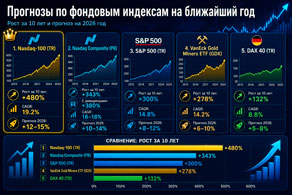
| Index / ETF | Region / Sector | Growth over 10 years | CAGR (annual) | Forecast for 2026 | Max. drawdown (%) | Comments |
|---|---|---|---|---|---|---|
| Nasdaq-100 (TR) | USA, high technology | +480% | 19.2% | 12–15% | –32% (2022) | Growth driven by IT giants (Apple, NVIDIA), a tech boom, and cheap capital. Some reversals are possible. |
| Nasdaq Composite (PR) | US, broad NASDAQ | +343% (+380% from dividends) | 16–18% | 10–14% | –30% (2020,2022) | Includes ~3,300 NASDAQ stocks, strong tech bias, broad base mitigates some of the risks. |
| S&P 500 (TR) | USA, broad market | ≈+300% | 14.8% | 8–12% | –34% (2020) | 500 largest US companies: Dividends boost returns and reduce volatility. More conservative growth. |
| VanEck Gold Miners ETF (GDX) | Global gold mining | ≈+278% | 14.2% | 6–10% | –50% (2016–18) | Growth depends on gold prices and geopolitics, with sharp fluctuations in 2016–2018 and a peak in 2020–21. An excellent diversifier. |
| DAX 40 (TR) | Germany, Eurosector | ≈+132% | 8.8% | 5–8% | –23% (2018) | 40 largest German companies, growth is moderate, dependent on exports and the European market situation. |
Over the past ten years, the Nasdaq-100 tech index has posted the biggest gains (+480%), driven by IT giants and the tech boom, while the gold mining sector (GDX, -50%) has posted the biggest decline, reflecting high volatility and sensitivity to gold prices and geopolitical risks.
Prospects and forecasts for 2026
As you can see from the table above, the stock market doesn't always go up in price, so when buying an index, it's a good idea to study the forecasts for the coming year.
Photo 1
Nasdaq100 – Analysts expect continued growth (CAGR 12-15%), though partial pullbacks are possible due to rate changes or a revaluation of technology stocks. Key drivers: AI, semiconductors, and cloud services.
Nasdaq Composite – projected to rise 10-14% in 2026. A broad stock base smooths out volatility, and the index continues to benefit from technology, but sharp swings are possible.
S&P 500 – moderate growth of 8-12% per year, stable fundamental US market provides reliability, but the pace will be lower than Nasdaq.
GDX – growth of 6-10% is possible with rising gold prices and increased geopolitical risks. During periods of economic stabilization, the ETF may underperform.
DAX 40 – growth of 5–8% is forecast with a stable global and European economy. The index is less susceptible to sharp fluctuations, with reversals likely only in the event of major external economic shocks.
Most analysts do not predict explosive growth for the market in 2026; experts give rather cautious forecasts.
US technology indices remain the growth leaders, but carry a high risk of correction. The S&P 500 is delivering balanced growth with moderate volatility.
The gold mining sector remains a useful diversification tool and a hedge against inflation, but record-breaking trends are not yet expected. The DAX 40 and other European indices are showing moderate growth.
Almost all indices are currently at their peak, so the smart move in the current situation would be to wait for a correction and enter at a more favorable price.