How to trade bonds on the stock exchange and get guaranteed profits
Bond trading on the stock exchange is one of the most underrated ways for a private investor to make money.

Many people perceive bonds only as a "deposit equivalent," but in practice, they can be used for active trading, earning money on changes in the price of securities and receiving coupon income.
This is especially interesting during periods of changes in central bank interest rates, when bond prices are subject to fluctuations, and the proper use of leverage can significantly increase income.
The bond trading strategy is quite simple, which is why this type of trading is popular among both professionals and beginners.
How to start trading bonds and how trading works
To get started, you'll need a brokerage account with access to bonds or bond CFDs. Choose a broker and open an account.
After this, the securities are selected and a transaction is opened through the trading terminal, which is downloaded from your broker.
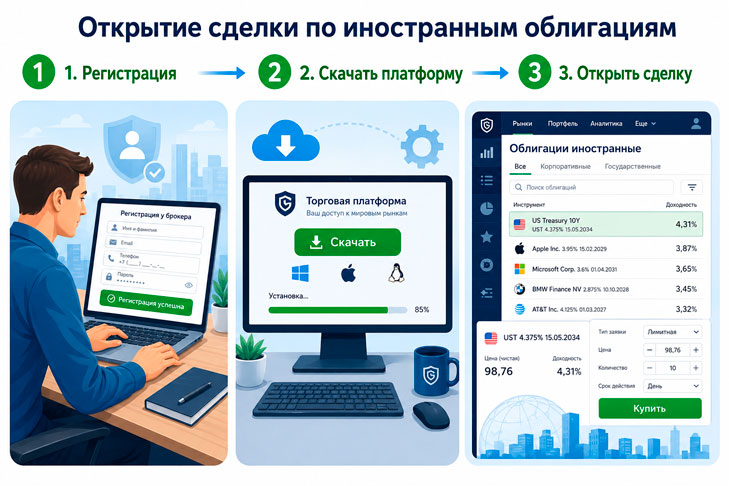
Active bond trading differs from simply holding securities in that the trader's goal is to profit not only from coupons, but also from changes in the market price of the bonds.
The most commonly used instruments for trading are US and European government bonds, large corporate bonds, and bond ETFs . Bond CFDs are particularly suitable for more dynamic trading , as they allow for leverage.
The essence of earning money on bonds is a ready-made trading strategy
The main trading strategy revolves around changes in central bank interest rates. When rates begin to decline, older, high-coupon bonds become more attractive. As a result, demand for them increases, and the bond price rises. Traders try to exploit this momentum.
This news can be found in the economic calendar.
For example, a trader has a $5,000 deposit and uses leverage . This allows them to open a position worth $50,000. The bond price on the market is below par, say $920. After news of a rate cut is announced, the price gradually rises by 8%.
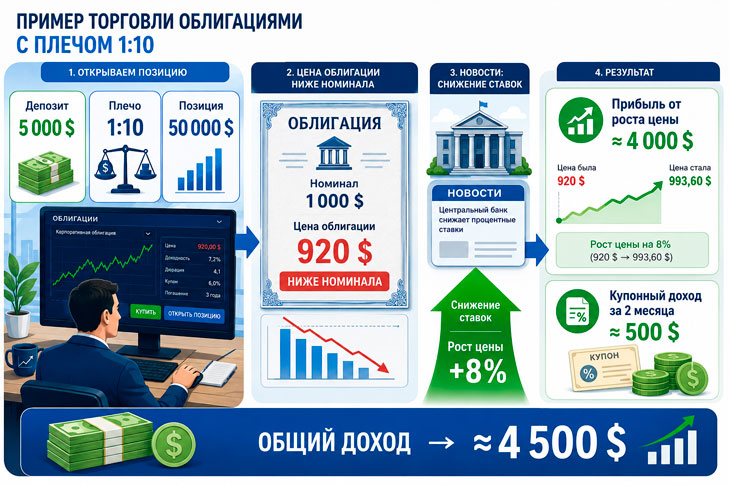
Using 1:10 leverage, an 8% price increase would yield around $4,000 in profit.
During the holding period, a coupon income is accrued, scaled by leverage. If the annual coupon is 6%, that's about $500 in two months.
The total profit on the position over a short period was about $4,500, almost equal to the deposit.
Another strategy option is to buy bonds shortly before the coupon payment.
Suppose a trader has a $5,000 and uses 1:10 leverageto open a $50,000. The bond accrues a coupon in three weeks.
- The coupon is accrued over three weeks: if the coupon yield for the year is conditionally 6%, then over three weeks for a position of $50,000 this is approximately $750 (taking into account leverage).
- The bond's price grows by 3% over this period. This price increase with 1:10 leverage yields $1,500 in additional profit.
As a result, the total profit for three weeks will be $750 (coupon) + $1,500 (price increase) = $2,250.
If a trader had opened a position without leveragefor $5,000, the coupon over three weeks would have been only $75, and the price increase would have been $150, for a total of $225.
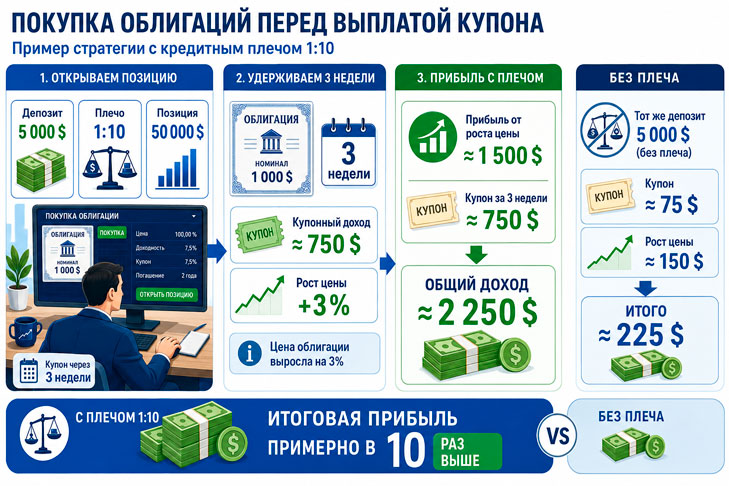
This immediately shows how the use of leverage scales both the coupon and the profit from price growth.
The nuances of earning money on bonds
Despite the relative stability of bonds, it's important to keep several factors in mind. It's best to choose liquid securities to open and close positions quickly. Leverage increases profits, but also increases risks—the drawdown on a position may exceed the initial deposit.
Practice on a demo account first
Selling bonds through CFDs allows you to open a short position and profit from falling prices, for example, if interest rates are expected to rise. Long-term bonds with low coupons fall particularly sharply, as they become less profitable compared to new issues.
It's best to combine long and short positions, and monitor central bank news to react promptly to market changes.
Leveraged bond trading allows you to profit from both coupon payments and bond price dynamics. A well-balanced combination of strategies—buying before rates decline, buying before coupon payments, opening short and long positions, and scaling your income with leverage—makes this type of trading one of the most effective ways to actively profit from bonds.