Gold at $5,000 per troy ounce already in 2026
As of December 13, 2026, a troy ounce of gold is trading in the $4,320–$4,350 range, up more than 60% since the start of the year. This is the highest annual increase since 2009.
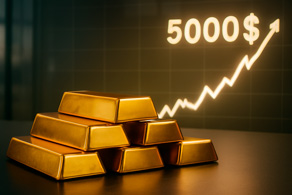
The reasons for the rise are not speculative, but structural. High inflation, falling real rates, record demand from central banks, and a loss of confidence in US debt instruments are at the forefront.
The market is pricing in expectations that these conditions will continue into 2026.
Just a couple of years ago, the idea of gold at five thousand per ounce was perceived as something fantastic.
Today, banks like JPMorgan, BofA, UBS, and a number of independent research centers are seriously discussing such a price.
And not as a hypothetical peak, but as a completely achievable milestone in the coming months.
Rate cuts boost gold prices
US interest rates are falling. The Federal Reserve has cut its rate twice in 2025, to 3.75%. Meanwhile, inflation has remained above 3.5% in recent months, and around 4% for a number of metrics (PCE, services). Real bond yields are near zero.
At the same time, the UST market is oversaturated—demand from international investors is declining, and the US authorities themselves are already openly discussing “the need to maintain low rates for the sake of budget stability.”
What does this mean in practice? Dollar yields are declining, and gold is gaining ground. Especially given that the Fed has little room for tightening under fiscal pressure.
This is what makes the precious metal attractive not only for short-term speculators, but also for large funds and central banks.
Central banks are exchanging dollars for gold.
Global central bank demand for gold remains a key factor. Since 2022, they have been purchasing over 1,000 tonnes annually. In 2025, official purchases totaled 1,027 tonnes, with preliminary estimates for 2026 at 1,050–1,080 tonnes.
China, Turkey, India, Qatar, Kazakhstan, and the UAE are leading the way. Gold purchases are replacing investments in US Treasuries. This isn't a tactic, but a strategy: central banks are shifting their reliance on the dollar toward physical reserves.
Between 2022 and 2026, central banks added over 5,000 tons of gold to their reserves. This is the largest five-year accumulation in modern history.
When everyone is afraid, metal wins
The geopolitical situation remains unstable. The conflict in the Middle East continues, Taiwan remains a hot topic, and the US is plagued by election tensions, a government shutdown, and a divided Congress.

Markets are reacting—an outflow from US stocks, a decline in interest in corporate debt, and a demand for safe-haven assets. Gold is rising in response to fears not for a specific country, but for the very stability of the global system.
Gold ETFs have increased by more than $64 billion in 2026, marking the strongest inflow since 2020. The reason is simple: gold is perceived as the last safe haven in a climate of global mistrust.
What leading analysts say
The most curious thing is how dramatically the opinions of not only banks but also independent analysts have changed. Previously cautious analysts are now confidently calling $5,000 a logical continuation of the current trend. Below is a summary:
| Source / Expert | Forecast for 2026 | Comment |
|---|---|---|
| JPMorgan | $5055 | Stagflation, rising share of gold in reserves, weak dollar. |
| Goldman Sachs | $4,000 (base), $4,500–5,000 | Departure from Treasuries, decline in confidence in the Fed, inflation. |
| Bank of America | $5000 | Fiscal deficit, debt burden, soft policy. |
| Societe Generale | $5000 | Geopolitics, ETF growth, high risk premium. |
| UBS | $4500 (base), $4900 | Interest of the Central Bank, growth of institutional demand. |
| Morgan Stanley | $4500 | Stable flows into physical gold and funds. |
| Deutsche Bank | $4,450 (avg.), $3,950–$4,950 | Limited supply, structural demand. |
| HSBC | ~$4600, up to $5000 | Devaluation of reserve currencies, instability. |
| Matterhorn Asset Mgmt | $6000+ | Debt crisis, flight to gold. |
| Metals Focus | $4600–4900 | Growing demand, institutional interest. |
| Incrementum AG | $4800 | Fragmentation of the monetary system. |
| Refinitiv / Reuters | $4500–4700 | Soft policy, geopolitics, ETF. |
| Independent experts | $4800–5200 | Broad consensus: $5,000 is a realistic goal. |
The main difference with the current rally is that it's not based on euphoria. Gold isn't becoming a trendy asset; it's simply being bought by those who no longer trust anything else.
The market is growing on systemic mistrust—in the dollar, in bonds, in monetary policy. And as long as this mistrust persists, gold remains the only anchor. $5,000 isn't a fantasy or a bubble, but a reflection of the imbalance in global finance.
If trends continue, the $5,000 level could be reached as early as 2026. And this won't be a maximum, but a new benchmark.