Martingale strategy in binary options
Martingale is one of the most popular capital management methods, which is  actively used in the Forex market and the stock exchange when trading almost any trading instrument.
Yes, martingale is considered the most dangerous trading tactic, but at the same time, it is the most profitable, and the trader who uses it experiences virtually no psychological stress due to the absence of losses.
But is this true? Does the most popular capital management method for beginners in the binary options market work?
So, let's look into this issue in more detail and try to build a clear picture of the application of the martingale strategy in binary options.
The roots of martingale and its essence
Martingale has its roots in gambling, specifically roulette and coin flips. The strategy essentially doubles your bet if you lose, and this model only applies when you have two options: black or red, heads or tails.
According to the Martingale strategy, you should double your bet and bet not ten dollars but twenty, again on black. If you win, you earn $20, and taking into account your previous losing bet, your net profit will be $10.
By doubling your bet, you essentially ensure that, mathematically, you'll ultimately win, because sooner or later, black will come up and you'll win. However, even when playing roulette with a fair bet, there's a huge drawback: your bet is many times larger than your potential profit in the event of a prolonged streak.
For example, let's imagine we bet $10 on black and hit the black number five times in a row in roulette. Now we calculate the amount of our bet to win back the original bet and earn a total of $10: $10 + $20 + $40 + $80 + $160 = $310.
Just imagine if your streak drags on, you'll be risking $310 for a $10 profit. Therefore, this method primarily requires a strong character and a large capital base.
Adapting the Martingale Strategy to Binary Options
Binary conditions, just like roulette, have only two winning conditions: whether the asset will rise or fall after a certain period of time. However, the first noticeable difference is the size of the winnings.
In the case of BO, the winnings are only 80 percent of the bet, while for pure application, 100 percent is required. However, let's skip all the nuances and try to create a simple martingale strategy for BO.
The first thing beginners forget is that martingale is a money management model, not a strategy for entering trades. Since the market is far removed from roulette in its specifics, and the range of probabilities is much greater than in roulette, if you mindlessly open trades against the market, you simply won't have the deposit for martingale.
To even out our odds, we need to add at least one indicator. For example, the broker Iq Option has its own platform where you can add a simple moving average.
Trading rules for betting on increases:
1) The price crosses the moving average from below to above.
The first thing you do is buy the option at the minimum stake!
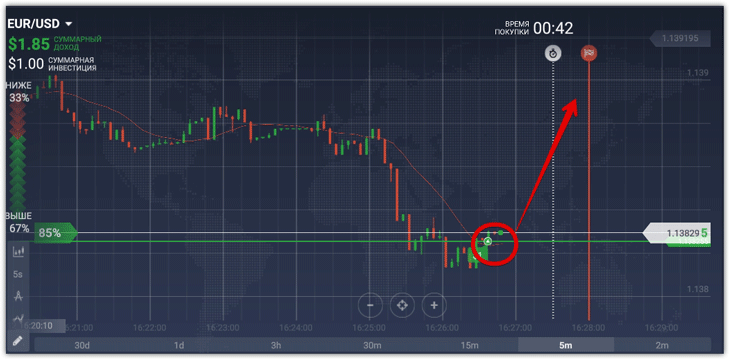
Trading rules for a bearish bet:
1) The price crosses the moving average from top to bottom.
The first thing you do is sell the option at the minimum bid!
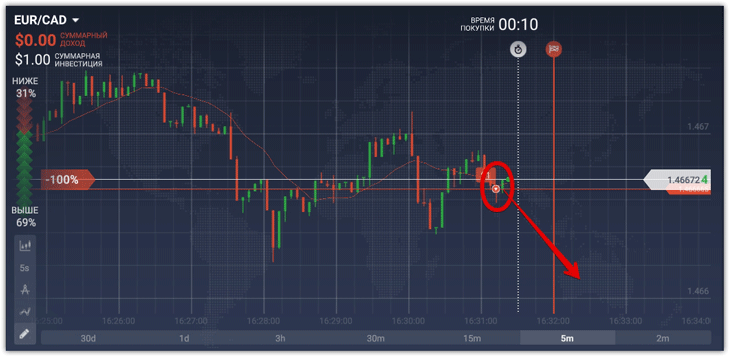
In the examples, trades were opened with a minimum bet of one dollar. In the first case, we made a profit, and in the second, we lost. According to the martingale, we double our bet and, when the next signal appears, we buy an option with a bet of $2.
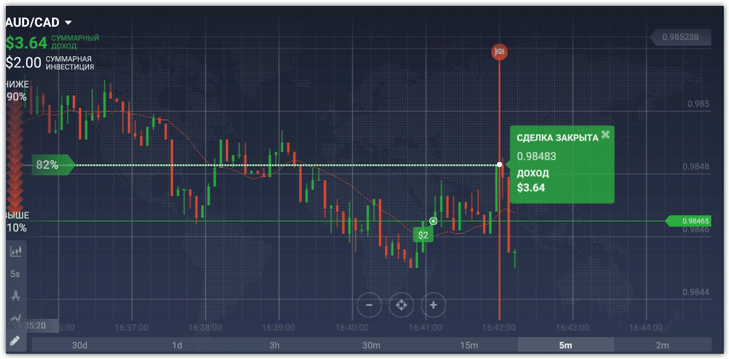
So, after doubling, we've earned $3.64. Now we do some fairly simple math: subtract the sum of both bets from our winnings to get our net winnings: $3.64 - $1 - $2 = $0.64.
In conclusion, I'd like to note that the martingale tactic can be safely applied when trading binary options. However, it should be clearly understood that in the event of a series of losses, the total bet after doublings can simply exceed your potential profitability by several times.
To avoid making the same mistakes over and over again, use martingale as a money management system in conjunction with specific indicators, rather than as a standalone strategy. As an example, consider the simple strategy we discussed in this article.