Flat market (flat on Forex).
The price of a currency pair always has a certain direction of movement: the exchange rate sometimes rises, sometimes, on the contrary, it rapidly moves down, but there are also periods when the quote practically does not change; this market state is usually called a flat.
A flat market is a relative lull on a currency or stock exchange, when the trend moves only horizontally and the price of the selected asset remains virtually unchanged.
Statistics show that the market is flat more than 60% of the time, so this aspect is quite important when studying trading. Knowing all its nuances allows you to profit even in such a situation.
The concept of flat is applicable only to a single time frame, since on a higher time interval the trend may already have a direction of movement.
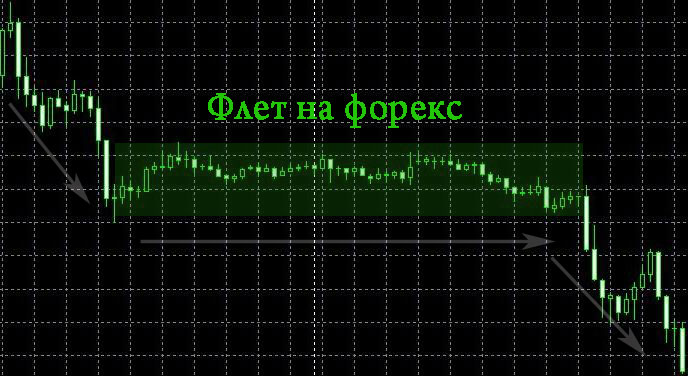
During these periods, the price typically doesn't stand still, but fluctuates within a small range, no more than a few points wide. The rate sometimes rises and sometimes falls, but these changes are so small that it's impossible to talk about an upward or downward trend.
Despite this, this market state offers excellent profit opportunities even for inexperienced traders, so it's crucial to take advantage of these opportunities and prospects.
Trading in flat.
There are two options for trading in a flat market:
• The first, the most popular and most commonly used, relies on pending orders. The strategy is based on the idea that any lull in the market is followed by a sharp movement in the direction of the future trend.
Since we don't know in advance the direction of the price, pending buy and sell orders are placed
Orders are placed slightly above the lows and highs of the existing flat to avoid false triggers.
In this case, the potential profit and loss should be immediately fixed. Take profit is set between 15 and 30 points, and stop loss is slightly beyond the minimum or maximum, depending on the direction of the trade. That is, if you place a pending buy order, the stop loss should correspond to the minimum price value during the Forex flat.
• The second option is more complex and requires several conditions, a price movement range of around 10 pips, and a small spread on the currency pair .
This is essentially trading within a narrow price channel, with trades opened as soon as the price reverses from one of the channel's boundaries.
Trading in this case occurs on M1 using high leverage, and the trade duration rarely exceeds a few minutes.
A similar trading option is described in detail in the article " Scalping in a Price Channel ."
A Forex flat is not a reason to give up trading; some traders specifically wait for the market to enter such a state and only then begin trading.