Trader Robert R. Prechter
Robert R. Prechter made trading history as the best trader of the decade with his phenomenal results in the Open Trading Championship.
Many of his predictions came true in the most unimaginable ways, and thanks to them, many investors were able to earn colossal sums of money.
It's worth noting that Robert made his mark on history thanks to the books he published, in which he revealed the essence of wave theory, as well as its practical application not only in financial markets, but also in sociology and psychology.
It was Robert R. Prechter who first linked the behavior of financial markets with the social behavior of ordinary people.
Moreover, his observations were set out in a separate book, where the author himself clearly cited the development of culture and fashion that coincided with the active growth of the stock market. Robert R.
Prechter is a great example of a talented person who was able to take his destiny into his own hands, and his biography is an excellent example for many aspiring people.
The only thing known about his family is that they were far from wealthy, so it can be safely said that everything he achieved in the future is solely his merit.
Education. Career
After graduating from high school, Robert R. Prechter entered a very prestigious institution, namely Yale University, in the Department of Psychology.
It is worth noting that Robert was a creative person, and during his student years he was interested in playing the drums and regularly performed at university concerts.
After graduating from university with a bachelor's degree in 1971, Robert completely forgot about his own education and plunged into the world of music.
So, for four years, Robert, together with his band, where he was the drummer, toured throughout the country, earning good fees from concerts.
It is worth noting that one of the band's songs was bought by Rod Stewart and made into a worldwide hit.
After four years of touring with a rock band, Robert began to see no future in a music career and decided to quit playing and start living a new, serious life.
His first job choice in 1975 was at the renowned investment bank Merrill Lynch, where he was happily accepted as a junior assistant analyst.
However, while working at the company, he managed to establish an excellent relationship with the manager, who laid the first foundations for understanding the work of wave theory and gave a huge boost to his development as an analyst.
After working for four years at Merrill Lynch, Robert formed his own opinion and observations regarding the wave theory, so he left the firm and created his own called Elliott Wave Internacional.
Own info bulletin.
And literally at the end of 1979, he created his first monthly newsletter on wave theory, called Elliott Wave Theorist.
In one of his newsletters, Prechter predicted that the market would soon turn bearish and that at the same time, gold prices would begin to fall.
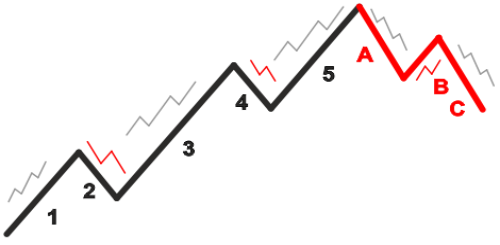
Despite the market being at a low point at the time of the forecast, the forecast ultimately came true, and all the company's clients who trusted the information earned huge sums of money.
After developing such a global forecast, Robert R. Prector became the talk of the world press, and he began to be actively invited as an analyst to various television programs, which naturally became a huge boost to the development of his company.
With the advent of fame, the analyst acquired many opponents, since Prechter was nothing more than a theorist and did not trade himself.
To counter the criticism, Robert signed up for the US Traders Championship, where he successfully took first place with a phenomenal return of 446 percent, quadrupling his capital.
Robert R. Prechter made a huge contribution to the development of financial literature, writing 14 books on wave theory and its practical application, and also published his major bestseller, The Elliott Wave Principle, as well as a book on a new branch of psychology, Socionomics.
Today, the company he founded, Elliott Wave Internacional, is actively operating, and Robert R. Prechter himself does not skimp on forecasts on television.