The Ichimoku Indicator – A Master of Long-Term Trading
The Ichimoku indicator is a trend tool that was developed back in the 1960s by Japanese  journalist Hosoda.
While working for the renowned Japanese stock market magazine Nikkei, Goichi Hosoda was constantly involved in market analysis, writing various educational articles and conducting analytical reviews of popular stock instruments.
After studying a ton of information, Hosoda decided to create his own technical analysis tool that would be capable of conducting long-term analysis.
As you can imagine, at that time the world was far from trading via personal computers, so Hosoda regularly hired students for practical training, who, roughly speaking, brought his idea to life with a pencil on a large piece of Whatman paper.
The Ichimoku indicator is a trend-following tool that can only be used on daily or weekly charts. While some DIY traders have found ways to optimize its parameters and use it intraday, the significant lag prevents such approaches from producing predictable results.
Many consider the Ichimoku indicator not a speculator's trading tool, but rather a tool for long-term investors, since positions opened based on its signals can last for weeks or even months.
Charting Ichimoku
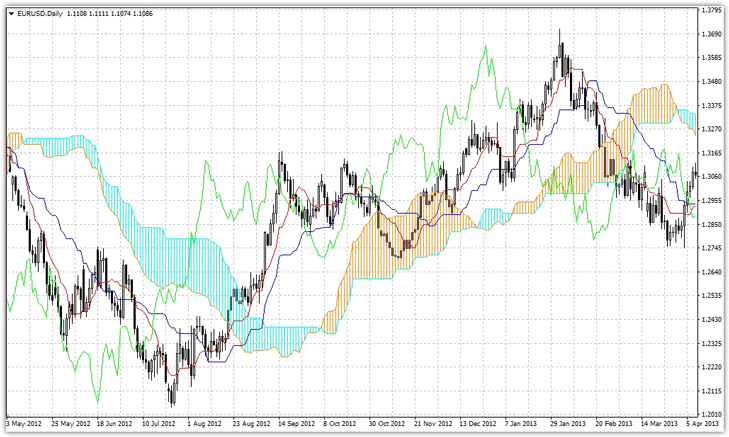
The Ichimoku indicator is a globally recognized technical analysis tool, so no matter which trading platform you use, it's included. In MT4, the tool is located in the trend indicators section, so simply drag it onto the daily chart of any currency pair.
Ichimoku Settings
The Ichimoku indicator consists of five lines that provide a vast array of trading signals and can even predict future trends. So, let's take a closer look at the lines:
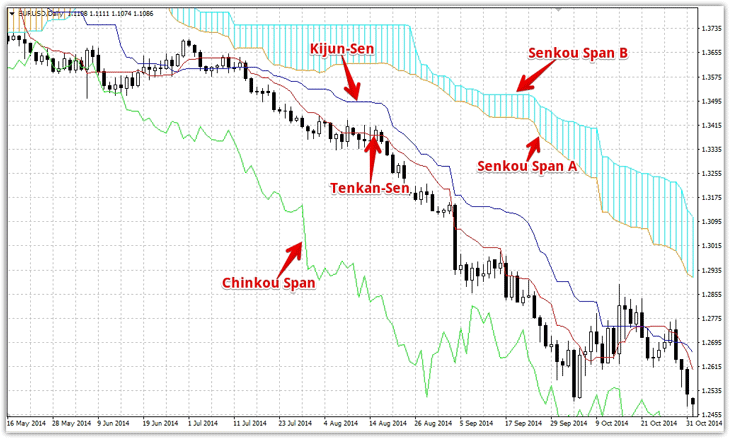
1 Tenkan-Sen. This line is constructed based on the average value between the high and low of 9 candlesticks. Simply put, the point for plotting the Tenkan-Sen line is the midpoint of the candlestick between its high and low.
On the chart it is colored red and shows the direction of the trend in the short term.
2 Kijun-Sen. The principle of constructing this line is no different from the Tenkan-Sen, except that it shows the medium-term trend and uses 26 candlesticks for calculation. It is shown on the chart as a blue line.
3 Senkou Span B. This line is constructed based on the Tenkan-Sen and Kijun-Sen principles, except it's shifted 26 bars to the right and uses the average value between the high and low of 52 candles. It's shown in blue on the chart and is part of the so-called "Cloud.".
4 Senkou Span A. This line isn't displayed in the indicator settings, but it's plotted halfway between the Tenkan-Sen and Kijun-Sen lines and is the brown line that forms the cloud. This line is also shifted forward by 26 candles.
5 Chinkou Span. This line is shown in green, shifted back 26 bars.
Ichimoku indicator signals
The Ichimoku indicator is a vast storehouse of trading signals, each with its own strengths and weaknesses. The most powerful signal is considered to be the "Three Lines Signal," which signals the strongest trend development.
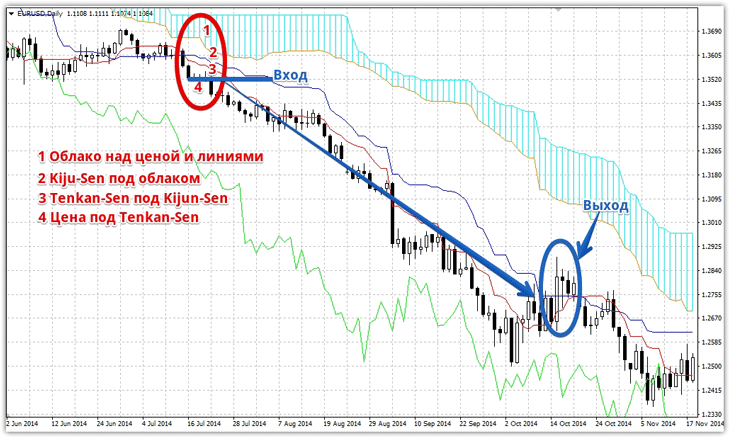
To enter a sell position, the lines should be in this position:
1) There is a cloud above the price and the Kijun-Sen and Tenkan-Sen lines.
2) There should be a Kijun-Sen line below the cloud.
3) There should be a Tenkan-Sen line below the Kijun-Sen line.
4) The price is below the Tenkan-Sen line.
If you see this configuration, you can safely enter a sell position. Exit the position when the price crosses the Kijun-Sen line. Example:
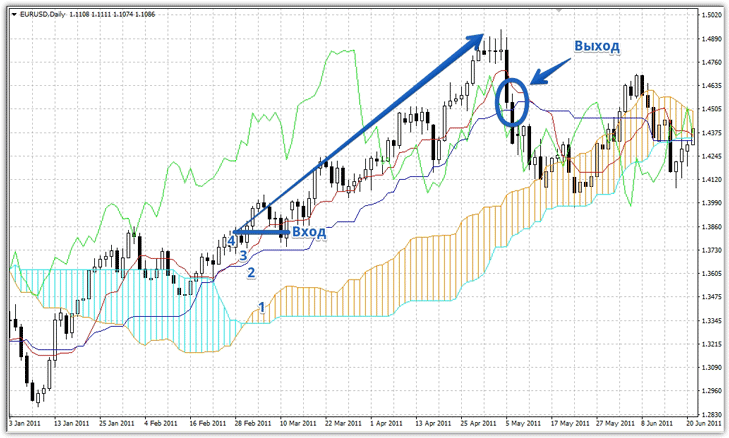
To enter a buy position, the lines should be in this position:
1) There is a cloud below the price and the Kijun-Sen and Tenkan-Sen lines.
2) The Kijun-Sen line should be above the cloud.
3) The Tenkan-Sen line should be above the Kijun-Sen line.
4) The price is above the Tenkan-Sen line.
If you see this configuration, you can safely enter a buy position. Exit the position when the price crosses the Kijun-Sen line. Example:
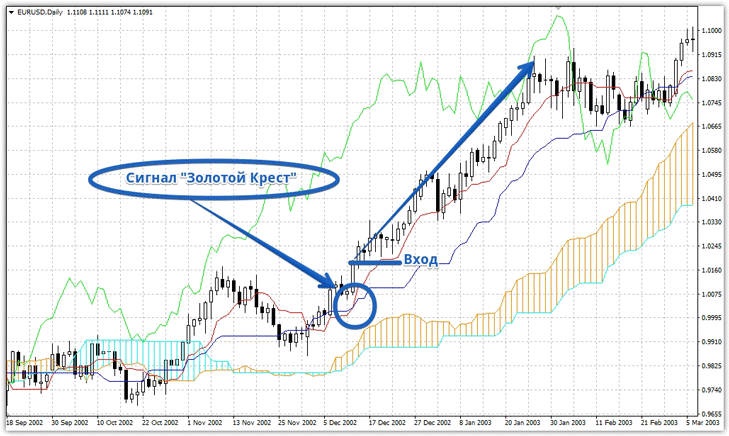
The Ichimoku indicator also gives a weaker signal called the Golden Cross and Dead Cross
A Golden Cross buy signal occurs when the Tenkan-Sen (red line) crosses the Kijun-Sen (blue line) from bottom to top. Example below:
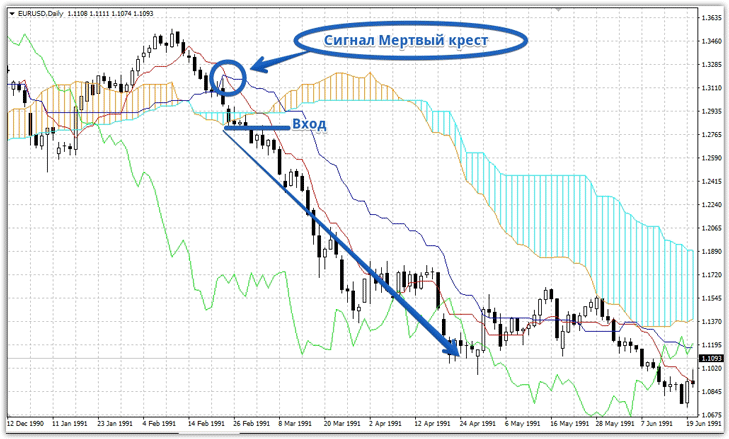
A Dead Cross sell signal occurs when the Tenkan-Sen (red line) crosses the Kijun-Sen (blue line) from top to bottom. Example below:
Warning signal of a trend change
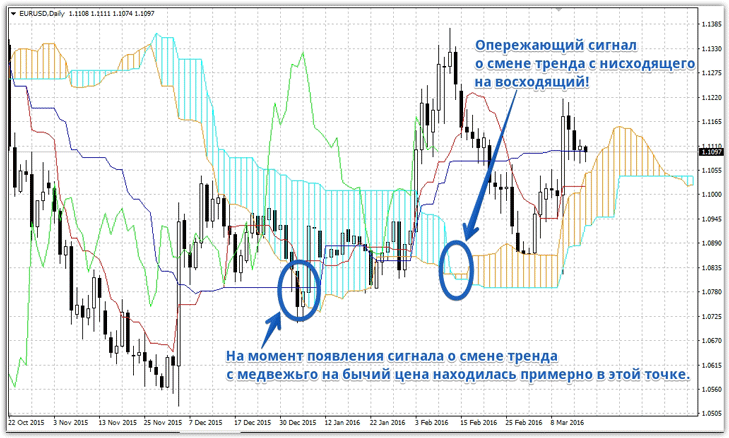
As previously written, the Senkou Span B and Senkou Span A lines, which are shifted to the right of the chart by 26 bars and form a cloud, can predict a future change in the direction of the trend.
It's worth noting that due to the 26 candlestick shift to the right, the cloud on history is quite difficult to show the effectiveness of this signal, but you should definitely know:
1) If the Senkou Span A cloud line crosses the Senkou Span B cloud line from bottom to top, a bearish to bullish trend reversal is expected.
2) If the Senkou Span A cloud line crosses the Senkou Span B cloud line from top to bottom, a bullish to bearish trend reversal is expected.
Chinkou Span trend change warning signal
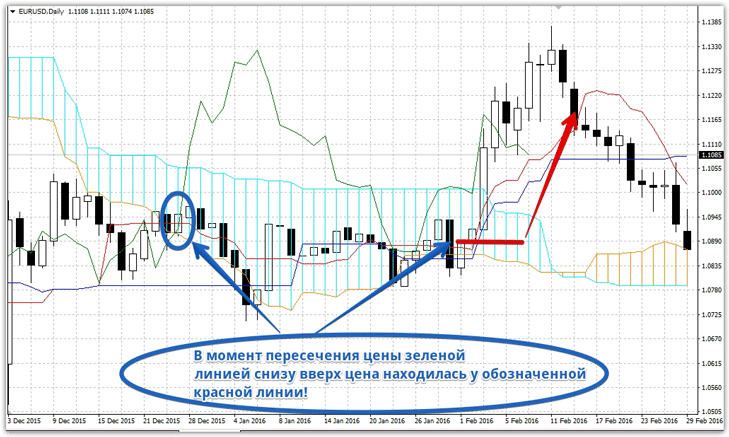
The Chinkou Span line is an excellent indicator of a global trend reversal. When we described this line, you learned that it is shifted back 26 candles. A global trend reversal is signaled when the price (chart) crosses the Chinkou Span line (green line).
1) If the green line of Chinkou Span crosses the price chart from bottom to top, the price will change its global trend to upward.
2) If the green Chinkou Span line crosses the price chart from top to bottom, the price will change its global trend to a downward trend. Signal example:
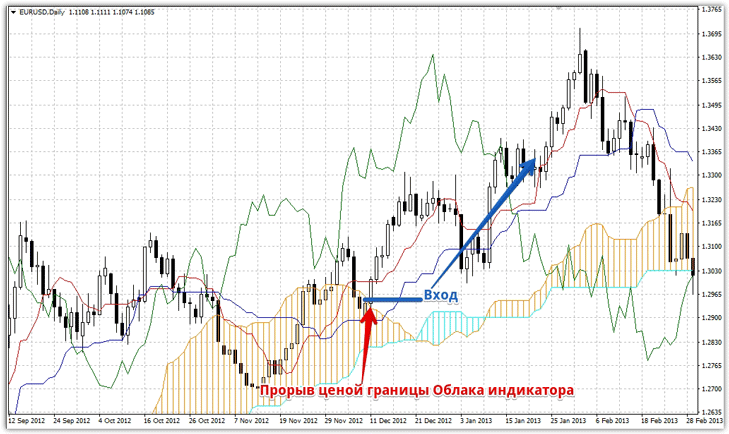
There is also an additional signal to enter a position when the price is inside the cloud formed by the Senkou Span B and Senkou Span A lines.
If the price has entered the cloud, these lines act as support and resistance lines, and signals for entering a position may appear in the event of a breakout of one of the cloud boundaries or in the event of a price rebound from one of the boundaries.
In addition to the signals discussed in this article, signals are also used when the price breaks the Kijun-Sen and Tenkan-Sen lines or bounces off these lines. The Inchimoku indicator is not just a trend-following technical analysis tool, but a full-fledged trading strategy that provides signals in virtually any market conditions.
The only thing every trader needs to understand is that Ichimoku is a tool for long-term trading.