How does inflation affect stock prices?
Recently, rising global prices have caused a significant increase in inflation rates around the world. How does this affect the stock market and is it worth buying shares now?.

In most cases, the impact of inflation on the price of shares in the stock market is negative and leads to a fall in prices.
The main reasons for the unfavorable situation with high inflation are:
Decrease in purchasing power – investors begin to spend more money on current needs, resulting in a decrease in the amount of free funds that could be used for investment.
Financial indicators are deteriorating – companies are suffering losses due to declining sales, people are buying fewer goods, and many companies are forced to reduce production volumes.

A decline in profits leads to a decrease in the size of dividends paid and makes investments in shares less attractive.
rising interest rates cause an outflow of money from the stock market, as investors prefer to buy government securities, which become more profitable than shares.
On the other hand, loans are becoming more expensive, including borrowed funds for companies that could be used for business development.
Inflation negatively impacts the country's economy as a whole, causing uncertainty about the future. Investors begin to shift their money to more stable assets, such as gold, thereby prioritizing safety over profitability.
At the same time, there is also a reverse trend: a decrease in the inflation rate has a positive effect on confidence in the stock market and causes the growth of most stocks.
This pattern is easily confirmed by historical facts.
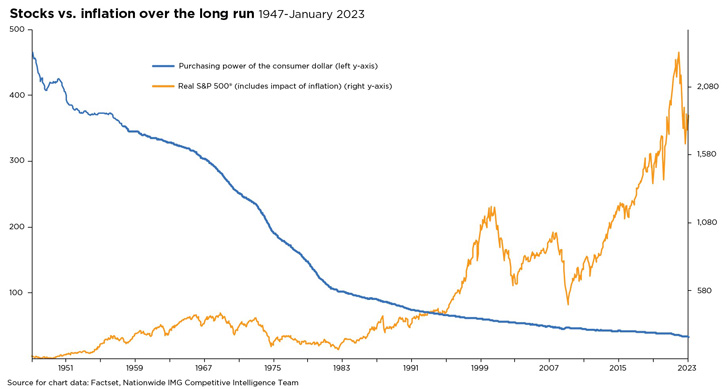
Examples of how inflation affects stock prices
Inflation in the US reached a record high of 8.6% in 2022. This led to a hike in Federal Reserve interest rates, which negatively impacted the stock market. As a result, the S&P 500 index fell by 16% year-over-year.
Inflation in China fell to 2.1% in 2023. This led to interest rate cuts by the People's Bank of China, which had a positive impact on the stock market. The SSE Composite Index rose 10% by the end of the year.
At the end of 2023, stock indices in most European countries showed growth amid reports of a weakening of price growth in the eurozone, that is, a decrease in inflation.
For example, the Stoxx Europe 600 composite index of European stocks rose by 0.4%, the British stock exchange index FTSE 100 rose by 0.3%, and the German DAX rose by 0.6%.
All of this suggests that investors should consider the impact of inflation when making stock investing decisions.
Stock trading brokers - https://time-forex.com/vsebrokery/brokery-fondowogo-rynka