Shorting Oil: How to Profit from Falling Oil Prices
Most novice traders are accustomed to the idea that they can only make money on oil after buying it and then watching its price rise.

But exchange trading also allows you to make a profit in the opposite situation – when the price of Brent or WTI falls.
To do this, the trader opens a sell trade, which is commonly referred to as shorting oil or taking a short position.
The further the price falls after opening a position, the greater the potential profit. However, if the market rises instead of falls, such a trade begins to result in a loss.
What is short oil?
Shorting oil is a trading operation designed to reduce the price of an oil contract. A trader first opens a sell position and then closes it with an opposite buy operation at a lower price.
For example, if a Brent short position was opened at $80 per barrel and closed after the price dropped to $76, the difference between the opening and closing prices is $4. The final financial result depends on the position size, spread, commission, and swap size.
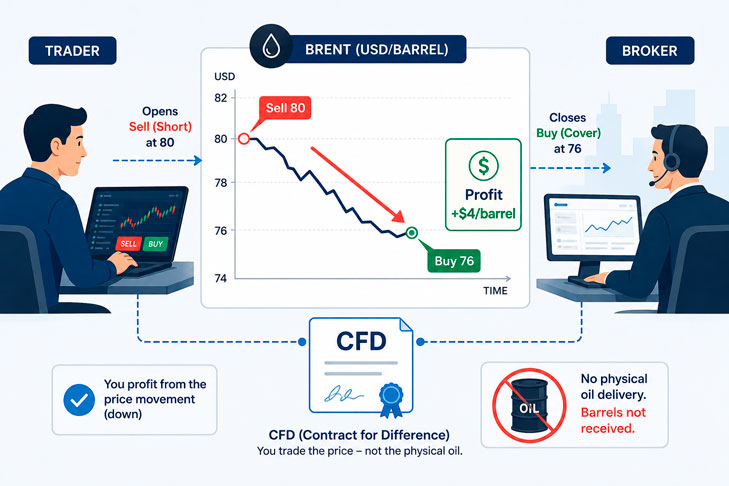
When trading CFDs, a trader doesn't sell actual oil or receive physical barrels. Instead, they enter into a contract for difference with a broker and receive a return based on the price movement of the selected instrument.
There are several ways to short oil, but for a retail trader, the easiest option is usually to open a Sell trade on a CFD through MetaTrader or another broker's trading platform.
Where can I short oil?
CFDs on Brent and WTI allow you to open a sell trade without purchasing the physical asset. Before trading, check the instrument symbol, contract size, minimum trade size, spread, commission, swap, and rollover rules.
Below are the brokers from the Forex broker rating that offer oil trading tools.
| № | Name | Year of foundation | Average spread | Number of clients | Initial deposit, dollars |
|---|---|---|---|---|---|
| 1 | Alpari www.alpari.com  |
1998 | 1,5 | 2 000 000 | 50 |
| 2 | RoboForex www.roboforex.org  |
2009 | 1,1 | 1 200 000 | 10 |
| 3 | AMarkets www.amarkets.org  |
2007 | 1,9 | 900 000 | 100 |
Broker terms and conditions change periodically. Before opening an account, please check the availability of Brent and WTI in your country, the account type, leverage, and contract specifications.
A Simple Stochastic Oil Shorting Strategy
To find the entry point, the standard Stochastic Oscillator indicator with settings 5, 3, 3.
A sell trade is initiated when the oil price moves lower, the Stochastic lines rise above 80, and then cross downwards. This suggests the short-term rally may be over and the decline may continue.
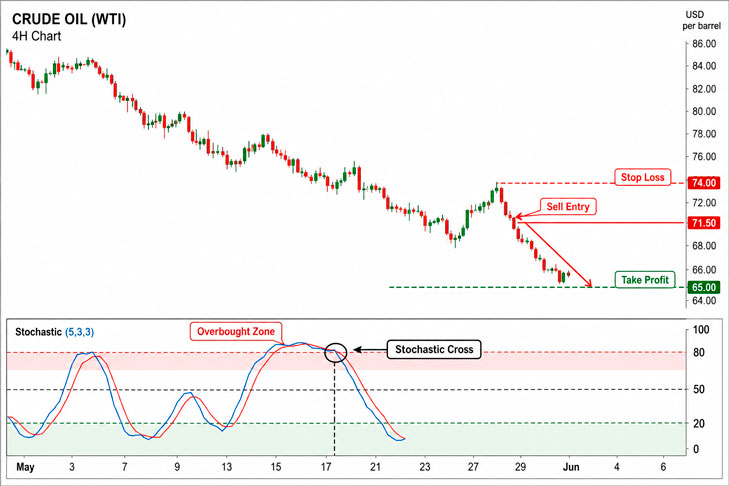
Example: Brent crude oil rose to $80, Stochastic entered overbought territory and reversed downward. A trader opens a sell order, sets a stop loss above the nearest high, and a take profit near the previous low.
What influences the fall in oil prices?
Even a simple short oil strategy must take fundamental factors into account. A sharp decline could follow a rise in oil inventories, a worsening global economic outlook, increased production, a stronger dollar, or decisions by major exporters to expand supply.
At the same time, the oil market can quickly reverse upon news of production cuts, military conflict, sanctions, supply disruptions, or damage to energy infrastructure. For this reason, it's best not to open a large position and carry it through important news without setting a stop-loss.
Shorting oil offers an opportunity to profit not only from rising oil prices but also from falling ones. Futures, CFDs, and other exchange-traded instruments can be used to open a short position.
The simplest strategy involves looking for a downtrend, a support breakout, and opening a sell trade after the price returns to the broken level. However, potential profit always comes with risk, so a short position should have a pre-set stop loss and a reasonable volume.