What are "Libraries for MetaTrader 4"?
Surely, many novice traders don't consider the functionality that awaits them when choosing a broker or trading terminal. 
Indeed, for many beginners, and even experienced traders, progress is practically unimportant; a price chart and a couple of indicators are sufficient, and sometimes nothing more than price action is needed.
However, the market is becoming increasingly complex year after year, and its movements are becoming less and less logical.
Therefore, traders are forced to consider gaining an advantage over other market participants, allowing them to open trades faster, conduct better analysis, and stay one step ahead.
It is precisely this pursuit of advantage that has driven the automation of processes in the forex market to the level we see today.
Libraries for MetaTrader 4 are independent software modules in the form of separate, standalone programs that allow you to expand the basic functionality of the trading platform for further use in either an advisor, an indicator, or a script.
Simply put, a MetaTrader 4 library file is an encoded list of functions that can be used when creating a custom MQL4 program.
It's important to understand that library applications can't be launched on a chart by a trader, unlike a script, Expert Advisor, or indicator.
These programs serve a support function directly for developers.
Where are MetaTrader 4 library files located? Basic purpose and application options.
Library programs, unlike indicators, Expert Advisors, or scripts, have a completely different file extension, ending with "mqh."
Library files can be stored in two folders: Include and Libraries. Even a completely empty trading terminal contains library files that enable the operation of a number of MT4 tools.
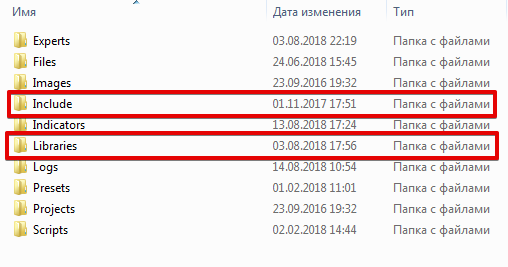
As we've already noted, libraries aren't used as standalone, independent analytical tools, but rather to expand functionality and enhance developer convenience. So, let's look at the basic tasks they solve.
1. Protection from hacking and copyright:
In almost 90% of cases, all paid advisors, whether purchased or obtained for free, don't work without a special library file responsible for protecting the robot.
It's worth noting that these files allow developers to link the same advisor to a dedicated server, preventing unauthorized users from exploiting their developments.
2. Creating Basic Blocks
: Programmers often perform the same code operations over and over again.
After all, every advisor has virtually identical basic functionality in terms of opening and closing trades, lot calculation, trade tracking, and interaction with the broker's server.
Typically, each programmer keeps such sketches in a separate notebook file. However, sometimes it's much easier to use a set of standard functions as a library, specifying just one line of code, rather than copying and pasting elements each time.
Newcomers to programming can also use libraries to find ready-made analytical solutions for their own programs, eliminating the complexity of implementing the basic functionality of any expert advisor or indicator.
3. Improving existing trading solutions:
With ready-made libraries, traders with little programming experience can implement specific, necessary functionality missing from the default advisor.
For example, the a-SimpleTrailing library file allows you to add two types of trailing stops to your advisor in just a few seconds, by writing just two lines specified by the library's author.
Of course, MT4 libraries are generally useless for the average trader.
However, this doesn't change the fact that they simplify the daily work of expert advisor developers and allow traders to implement certain modules into an advisor without any programming knowledge.