Pyramid of pending orders.
There are different approaches to making trading decisions. Traders generally  classify strategies as indicator-based, which rely on a combination of indicators, and indicator-less strategies.
Indicator-free strategies are built based on the principles of price behavior patterns, various candlestick patterns, and graphical figures.
However, there is another type of strategy that doesn't even attempt to show us a market entry point or predict future price behavior. All trading boils down to opening a grid of orders in both directions, so that no matter where the price goes, it tries to maximize its profit.
In professional language, such traders are also called "Griders", and the method itself is called "griding".
Basic principles of the pending order pyramid.
Any network is built on two types of pending orders: stop orders and limit orders. As you probably already know, stop orders are executed in the direction of the trend, while limit orders, on the contrary, resemble counter-trend trading, as they are triggered to buy when the price falls, and to sell when the price rises.
This is where the fundamental difference between the two types of grids comes from: while the first type follows the price fully, the second type focuses on buying low and selling high. So, having covered the basic types of grids, let's move on to the principles of construction.
To properly construct a network, it's necessary to select a specific distance in points as a constant, which will not change under any market conditions when constructing the network. The distance between pending orders is selected based on the characteristics of the currency pair. Moreover, the more frequent flat movements are, the greater the distance between orders is to avoid unnecessary openings of both sides.
So, for our example, we'll set the order spacing to 20 points. Therefore, we need to build a network of pending orders located above and below the price. At a distance of 20 points from the price, two pending orders are opened: a buy stop above and a sell stop below.
Next, we need to expand our network by adding four pending orders above and below the price, 20 pips above and below the price. An example can be seen below:
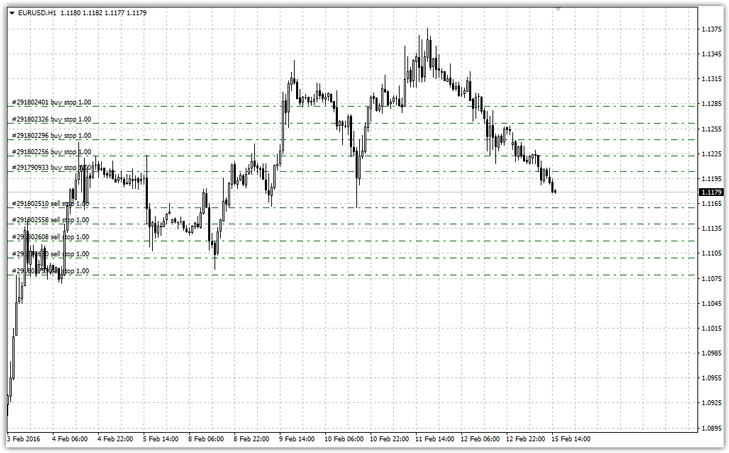 Once we've built the network, all that's left is to wait for the price to move in any direction. Regardless of where it goes, a series of orders will be opened. However, trading doesn't end with the placement of the pending order network. As the price moves in any direction, pending orders should be placed according to a predetermined constant.
For example, if a pending buy stop order is triggered and the price moves 40 pips, you should trail sell stop orders from below at a distance of 20 pips from each other and the price. In such grids with a standard lot, the profit is set at a predetermined constant size, namely, 20 pips in our case.
Pyramid of pending orders
While a static lot size is often used for all stop-loss orders when constructing a network of pending orders, a pyramid of pending orders is commonly used with limit orders. As we've already discussed with limit orders, a buy occurs when the price falls and a sell occurs when it rises.
Therefore, the price may often continue to move further when you open an order, and if the grid continues to decline for a long time, you'll open a series of buy orders. To reduce risks and exit the market profitably through averaging, each subsequent grid order is doubled in size, so that the slightest pullback results in a full grid closure.
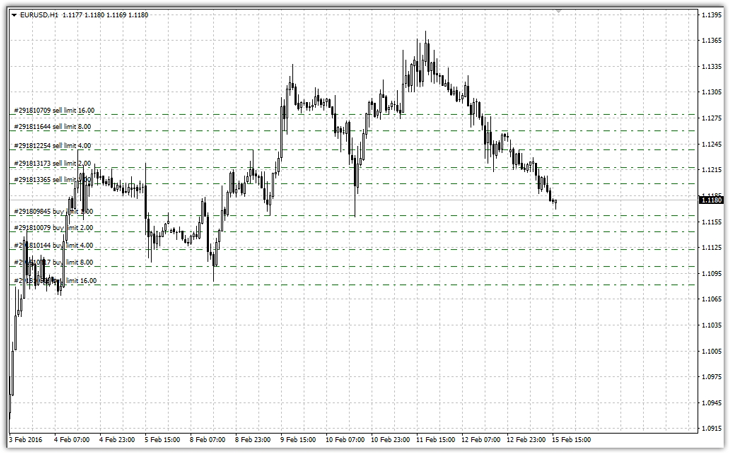 Unlike working with a static lot, a trader typically waits for a total profitable profit and closes the entire grid once the target is reached, after which the grid is rebuilt.
When using a pyramid of pending orders or a grid system with a static lot, you must be fully aware that you will be in the market almost all the time. It is for these obvious and simple reasons that you increasingly see advisors , rather than traders practicing it manually.