Sperandeo's method
Many critics of technical analysis always argue that the construction of certain figures and lines  depends on the trader's subjective opinion. This type of analysis has no clear rules, and while one trader sees support in one place, another might draw it in a completely different spot.
When it comes to constructing trend lines, the situation is even more bleak.
According to the rules, at least two extremes are required to construct a trend line. But here's the catch: everyone chooses this extreme for themselves and attaches importance to it, which leads to the line being constructed incorrectly, and its signals are either false, or you simply miss a real reversal and enter the market too late.
Renowned trader Victor Sparandeo faced this problem. He became world-famous after publishing his book, which offered a solution to this pressing issue. Incidentally, he is one of the few traders who wrote a book after achieving success in the stock market, rather than, as is often the case, after a career failure.
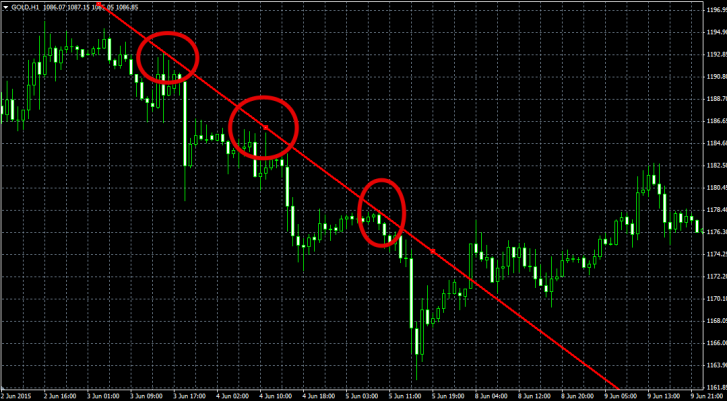
The author of his method proposed clear rules for constructing trend lines, which state that a trend line is constructed based on successively lower highs (for a bearish trend) or lows (for a bullish trend) that precede the lowest extremum.
In simple terms, you should select points for construction not based on subjective opinions about their importance, but on two or three extremes that precede the lowest extremum (the current price decline or rise). Moreover, the author emphasizes that a point can be considered an extremum if, in a bullish market, this low is broken by an upward movement, and in a bearish trend, the high is broken by a downward movement.
Simply put, only those local highs and lowsthat were surpassed by the price are taken into account. You can see an example of constructing a line using Sperandeo's method in the image below:
Based on his construction method, the author developed his own trading strategy called "Trend Change at 1,2,3." The essence of this method is that when a trend line is broken, it automatically becomes a support line.
Based on these observations, using the 1-2-3 pattern as a basis, the author asserts that a trend has changed if three conditions are met:
1. The price has broken the trend line.
2. The second step is for the price to return to the trend line, which in turn becomes its support.
3. After a pullback, the price must break the extreme level formed as a result of the trend line breakout.
These rules form market entry signals. So, we enter a position after the price, following the above movements, breaks the level we specified in the third condition. You can see an example of an entry in the image below:
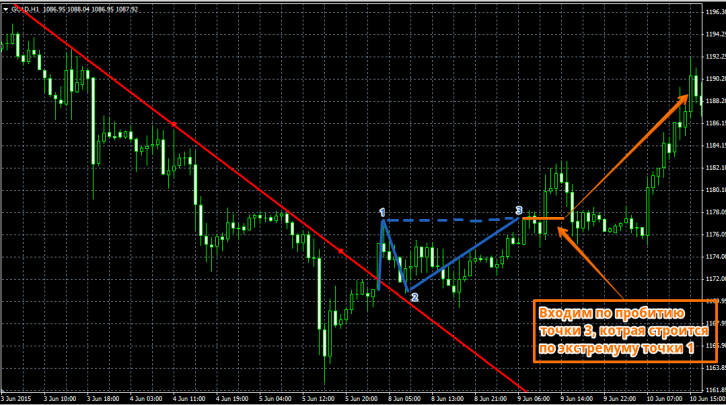
With a buy signal, the entry conditions remain the same, the only difference is that you'll draw a trend line with reversal points in a bullish market. Stop orders are typically placed at local highs and lows.
If you look at how this trading method works historically, you'll be pleasantly surprised that you no longer need any indicators to identify reversals. This method, in addition to providing clear market points, will also help you accurately and confidently draw trend lines, an invaluable tool that has proven itself to be highly effective.
Thank you for your attention, gentlemen, and I hope you'll never again have to wonder where to draw a trend line. Good luck!