Stop out is a forced closing of a position by a broker
The main attraction of trading on the forex market is the use of leverage provided by a broker, which allows you to significantly increase the funds available for trading.

In order to protect their funds from loss, the broker uses stop out.
Stop out is an order to forcefully close a trader's position once the loss reaches a certain level specified in the trading conditions.
Serves to protect the broker's funds when using borrowed funds from the broker to support an order of a larger volume than the trader's deposit.
Each brokerage company independently sets the loss value, upon reaching which the order will be automatically closed.
Typically, brokers set the Stop Out size at a level of 10 to 30 percent; you can get more precise information in your broker's trading conditions:
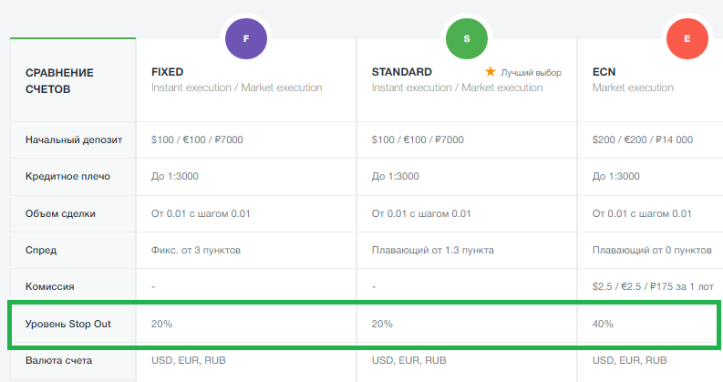
Let's consider a similar situation using a specific example.
The stop-out level is 10%, the trader's deposit is $2,000, and the leverage used is 1:100. A trade of 1 lot, or $100,000, is opened, with the trader's funds serving as collateral in the amount of $500.
Moreover, the broker’s trading conditions state that the stop-out level for this type of account is 20%, which is based on our margin - 500*20/100 = 50 dollars.
An unfavorable situation developed on the forex market and the loss on the open order began to gradually increase. As soon as it reached the amount of $1950, the position was automatically closed.
However, the trader's account will not necessarily remain exactly $50, since closing a position also takes time, and the price does not stand still.
A stop-out is a type of stop-loss order, but only on the broker's side. It allows the trader to avoid losses if the situation arises and the trader is unable to handle it independently
 When calculating this, remember that multiple positions may be open in the trader's terminal at the same time, and the total volume of trades must be taken into account.
It's advisable not to wait for a forced position closure and instead close the order when a message alerts you that there may be insufficient funds to support the position.
This signal is called call . It is typically sent to a trader when losses exceed 50-70 percent of their available funds.
Today, it is not necessary to perform calculations manually; it is enough to install the appropriate script:
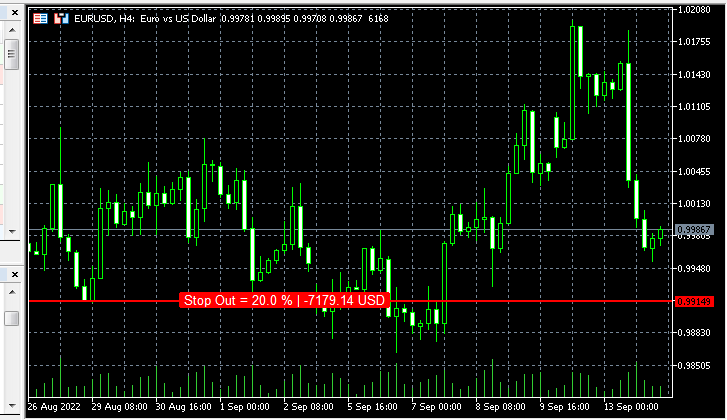
Download the Stop Out script for installation on the chart - https://time-forex.com/skripty/ind-stop-out
Is it possible that the stop out does not work and the deposit goes into the negative?
Surprisingly, yes, this usually happens for two reasons:
• Poor collateral for an open position, when high leverage is used for trading and the trade volume significantly exceeds the trader's deposit. For example, the deposit is $100, and the trade is opened with a volume of 1 forex lot (100,000). In this case, the trend only needs to move 10 pips to wipe out the deposit.
• The occurrence of a gap - a stop out may not be triggered if a price gap occurs (forex gap), sometimes its size reaches several tens of pips. This leads to a negative deposit.
But fortunately for traders, almost all brokers guarantee the restoration of the negative deposit value to zero.
However, it is still better to independently regulate the level of possible loss by placing stop loss or trailing stop orders.