A simple flat trading strategy for Forex and stock market trading
The trend does not always move upward or downward; sometimes the market becomes relatively calm and the price moves horizontally. Many traders consider such moments unfavorable for trading.
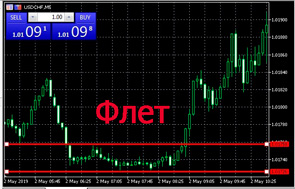
On the contrary, it is precisely at this time that I earn the greatest profit; when using the flat strategy on Forex, it practically does not fail.
The flat strategy is extremely simple; it is based on placing pending orders that are triggered immediately after the emergence of a dynamic trend.
In practice, you are conducting automated trading, participating in trading only at the very beginning, setting the main parameters of a new order.
A new order will open if a new trend begins and will close as soon as the profit reaches the level you set.
Basic conditions for applying the flat strategy in practice
The first condition for using the flat is the presence of a relatively weak trend on the Forex market, that is, the price should not change by more than a few points within an hour.
At this time, the market is waiting; the situation is rather uncertain, and it's unclear where the price will go in the near future. A narrow price channel within which the price moves, the width of which is no more than 100-150 points for a five-digit quote.
Based on the minimums and maximums, it is easy to construct a horizontal channel that will clearly show the market situation.
Once you've identified this situation, which can happen with virtually any currency pair, we begin applying our trading strategy.
At the initial stage, the flat strategy involves the following actions:
1. We analyze the trend —or more precisely, the width of its corridor—that is, we find the minimum and maximum since the flat began. For example, the hourly price minimum was 1.2535, and the maximum was 1.2555. These will be our starting points for placing pending orders.
2. Buy order – we place it 10 points further than our maximum, for example, at 1.2565. In this case, we will avoid false breakouts and the order will only be triggered when a new trend appears. This value can be changed, depending on the width of the range in which the price moves.
Stop-loss – we place it 10-15 points below the order trigger level, since there is a possibility that the order will trigger and the price will begin to fall, and in this way we will protect our deposit from being lost.
Take profit - set 10-15 points above the price level, for example, 1.2580. Don't overestimate the planned profit, as if the price reverses, you'll not only miss out on your 15 points, but you might also end up with a stop-loss.
3. Sell order - we place it according to a similar scheme, only 10 points below the minimum price, that is, based on our example, at point 1.2525.
Stop loss in this case will be equal to 1.2540
take profit in the region of 1.2510
After all, in this case we work in the opposite direction, so in order to make a profit we need to close the deal below the opening price.
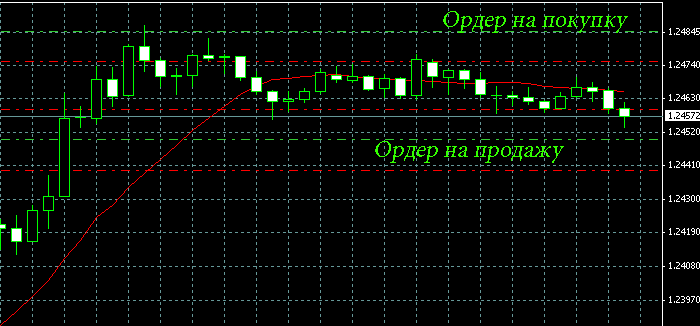
Out of habit, I write four-digit quotes in the description. Obviously, if you're working with five digits, you should make adjustments and increase the values by 10 times.
In my personal experience, the flat trading strategy yields over 70% profitable trades, so when applied correctly, the final financial result is always positive.
If you wish, you can always make your own adjustments to this trading option and increase your profits or reduce your losses, but why change anything if this is a truly working Forex strategy for flat trading?.
An indicator that will help make your strategy even more effective - https://time-forex.com/indikators/bb-trend-flat
You can find other equally effective trading strategies at the link - http://time-forex.com/strategy