Trio Dancer Advisor
Trio Dancer is one of the most well-known expert advisors, based on standard indicator readings. The advisor includes three different strategies, but testing revealed that two of them are very similar, with orders opening close to each other in the same direction. The third strategy is clearly counter-trend, as it almost always opens against the trend.
The strategies consist of two moving averages with periods of 9 and 5, Stochastic Oscillator, RSI, and CCI. As you can see, this is a fairly standard set of indicators familiar to almost any novice trader.
The expert advisor is multi-currency and can be configured to work with any currency pair. The author recommends working with the GBP/USD and EUR/USD pairs. The time frame is at the trader's discretion, but it's important to remember that the expert advisor is based on standard indicators, which produce many false signals on short time frames.
A detailed analysis of the expert advisor revealed that it uses martingale to cover losing positions. In the Global Settings block,you can set the initial lot (lot), the multiplier for subsequent positions (LotExponent), and the maximum lot the advisor can open in the event of a series of losing positions (MaxLots). In the Money Management (MM) section, you can set the profit in points (TakeProfit) and set a stop order. However, given that the advisor is a pure martingale, the stop order line should be ignored.
Each strategy's advisor settings have a specific block named "MaxTrades," where you can set the maximum number of orders for the strategy (MaxTrades), the use of a trailing stop (UseTrailingStop), and the starting point for trailing. You can also set the number of pips between orders (PipStep) in each strategy block.
When I started testing in the strategy tester, I encountered very slow data processing, which is often typical for complex experts. Therefore, for the first test, I chose a one-month period with standard settings. The EUR/USD pair was traded on an H1 timeframe.
The test results are shown in the image:
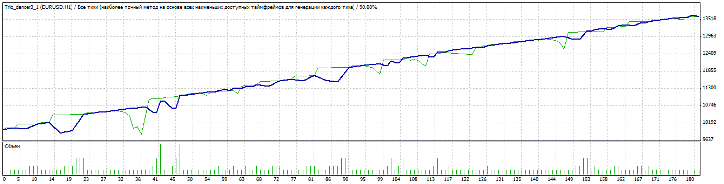
As you can see in the image, the monthly profit was 43%, with a risk of almost 26%. You can also see in the chart that the equity line is level or slightly above the balance line. This means the EA is profitable. However, at the end of the test, the equity line drops, indicating a large number of orders placed in the wrong direction. This sharp drop in the chart indicates that parameter optimization is necessary.
In the second test, I decided to increase the distance between orders to 40 points and increase the multiplier from 1.5 to 1.8. You can see the test results in the image:
As you can see, the equity line leveled out at the end of the test, and our drawdown dropped to 11 percent. Profitability decreased slightly, but stability increased.
Before deploying the EA to a real account, be sure to optimize it, as I conducted the tests on a very short period.