Forex trading tactics
Like any other endeavor, stock trading requires a plan of action that outlines all  the key aspects of trading. These are the foundation of profitable trading and prevent you from losing your deposit.
Forex tactics are an integral part of a trading strategy. While a strategy covers only general aspects, tactics focus on the details—though there are no details in forex trading.
In our case, this discipline encompasses all the preparatory aspects of trading and also regulates the key performance indicators.
This includes calculating the optimal trade size, the maximum loss and profit that will be reached when the order is closed, and methods for securing profits.
Tactica Adversa.
Tactica Adversa is a relatively new direction in the field of graphical analysis, and this approach has been on its way since the early 2000s.
If you start searching Google and try to find useful information about strategy, you will probably come across a number of abstruse words about esotericism and sacred points, as well as all sorts of expressions in this spirit.
It's worth noting that the author's explanations of the strategy are so abstruse and mystical that after reading a couple of paragraphs, any sane person will close the book.
Perhaps this approach has become a thing of the past, and traders have lost interest in it due to unclear and sometimes illogical explanations, while a clear algorithm of actions for a trader is out of the question.
However, despite the author's verbal exaggeration of the technique, it is based on just two simple patterns that you may have also observed repeatedly on the chart.
Pyramid of pending orders.
There are different approaches to making trading decisions. Traders generally  classify strategies as indicator-based, which rely on a combination of indicators, and indicator-less strategies.
Indicator-free strategies are built based on the principles of price behavior patterns, various candlestick patterns, and graphical figures.
However, there is another type of strategy that doesn't even attempt to show us a market entry point or predict future price behavior. All trading boils down to opening a grid of orders in both directions, so that no matter where the price goes, it tries to maximize its profit.
In professional language, such traders are also called "Griders", and the method itself is called "griding".
Tactics for Waiting Out Losses: Death for Beginners and Salvation for Professionals
It's no secret that more than 50 percent of your future success depends on your choice of trading tactics, but the remaining 30-40 percent can affect the effectiveness of your strategy.
They directly depend on the chosen capital management model, and to a large extent on how you will manage the transaction and limit risks.
Today, there are more than a dozen capital management models and approaches to transaction support, but they can be roughly divided into two groups: loss-cutting tactics and loss-waiting tactics.
The loss-waiting tactic is an approach to risk management, in which the trader either does not use a stop order, or there is a very small profit and a very large stop order.
Order Flow: A Universal False Signal Filter
Order flow is a truly powerful tool that  allows most traders to see through the market.
The ability to recognize a major player and the size of their order, and an understanding of who is really in the market, namely the bulls or the bears, always allows for a general understanding of the future price movement.
However, as with trading any instrument, false signals always arise, which must be properly filtered. In the forex market, you won't be able to see the order flow as such, except for information shared by the dealing centers themselves. However, the topic of a universal filter for eliminating false signals is relevant, regardless of your trading style.
Tactics – Quickly Increase Your Forex Deposit, Expert Advisors, and Indicators
The main problem that most traders starting out in Forex face is a lack of  funds for trading.
Some people have only a few hundred dollars in their accounts, while others have much less.
There is only one way to solve this problem: by increasing the deposit.
Forex deposit boosting is a rather risky tactic that allows a trader to increase their deposit several times over in a short period of time.
In fact, this is scalping, all profits from which are added to the main account amount and then used in trading.
Lose-free trading tactics.
Every trader would like their trades to close only with a profit, but the standard trading terminal provides  two options for closing trades: take-profit with a profit and stop-loss with a loss.
A trailing stop is an additional solution, but it has some drawbacks that traders don't fully appreciate.
To reduce the number of losing trades and thereby increase overall financial results, other approaches can be used.
Primarily, this includes moving the stop-loss to the break-even zone or even locking in a certain amount of profit.
Partial position closing tactics.
When trading Forex, you often encounter a situation where a successful trade becomes  unprofitable after a sharp trend reversal.
You're left regretting that you didn't close the position in a timely manner, but at the time, you were thinking about maximizing your profit and there was no indication of a potential reversal.
In such a situation, it's best to find a compromise that allows you to profit without closing a promising order.
This can be achieved by partially closing the position, without opening any counter orders, which would increase the spread and further complicate your trade.
Trading on pullbacks.
Almost every other article on Forex trading recommends trend-following trading, as trend-following trading  is less risky.
However, instead of the promised profit, traders only receive stop-loss orders. As soon as a new trade is opened, the trend immediately reverses, raising suspicions about the dealing center's dishonesty.
However, there's nothing criminal about this phenomenon, as these are normal pullbacks or trend corrections.
Why do most authors so insistently recommend opening trades with the trend? Because their articles focus on trading on medium- and long-term timeframes, and most traders engage in intraday trading using fairly high leverage.
Tactics - stop loss plus take profit.
This is one of the most common tactics in Forex; most traders, without even realizing it, intuitively employ  stop orders.
Essentially, the stop-loss plus take-profit tactic implies that, regardless of the trading strategy used to generate profit, two stop orders are always placed before the trade is initiated.
Moreover, their placement follows the same rules; this is the tactic; there are many variations of these rules, which we will discuss below.
First of all, it's important to remember that stop-loss and take-profit orders are placed at the moment of opening a position, not after the order has already been placed. Both orders are important: the stop-loss protects the deposit, while the take-profit allows you to take profits and eliminate market pressure on the trader.
Reversal with doubling.
A Forex trend consists of fluctuations in the exchange rate, some of which 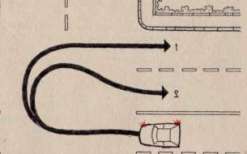 occur against the main trend. For example, if the price of a currency pair is rising, it's highly likely to fall soon, even if only by a few pips. The "Reversal and Double" tactic is based on this fact.
When opening a position, traders are confident they've chosen the right direction, but this belief isn't always true, and losses on a recently opened order continue to mount. In this case, the position reversal tactic is used.
The key to using this tactic is choosing the right place to close a Forex position and reenter the market to avoid making another mistake.
A practical example illustrates the use of a reversal tactic:
Averaging in Forex.
There are many different trading tactics in Forex, including some quite dangerous ones. Averaging is one of them. In some ways, this trading approach resembles Martingale, but at the same time, it has its own distinctive features.
Averaging in Forex is a counter-trend strategy in hopes of a quick reversal or major correction. Using this technique, a trader, despite current losses on existing positions, opens new ones in the same instrument and in the same direction.
The essence of this method is to balance the financial result by opening a second trade at a more favorable price. For example, by buying one lot of euros at 1.2545, you incurred a loss of 10 pips, and the current price is 1.2535. If you open a new order at the existing rate, then if it rises by just 5 pips (excluding the spread), both trades can be closed with a breakeven result.
Multiple Lot Tactics in the Forex Market.
There are several tactics in the forex market designed to increase profits  . One such tactic is the multiple-lot strategy, though its catchy name conceals well-known techniques.
A more accurate term for this tactic would be position expansion. It's a rather risky method of profit generation, whereby gains are achieved not through time, but by increasing trading volumes.
Almost every forex trader who doesn't have a large capital base but wants to quickly make a significant profit employs something similar.
Anti-Martingale Tactics in Action
As is clear from the name of this term, this concept has some relation to the Martingale trading tactic, but unlike the latter, completely opposite trading principles operate here.

Anti-martingale – in a global sense, this is an approach to capital management that involves increasing the position after each successful trade and decreasing the order volume after each unsuccessful trade.
Unlike the classic martingale system, where each subsequent trade is doubled, the anti-martingale allows investors to increase their trades only after wins, not after losses.
Using the anti-martingale approach allows traders to better manage their capital and reduce the risk of losses.
Forex pending orders and trading tactics using them.
There are many strategies that utilize this trading tactic; the pending trading option 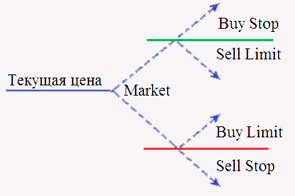 allows for automated trading without the use of third-party scripts.
But in this case, all the work of analyzing the trend and making forecasts falls entirely on you.
Pending orders allow you to not only set the price at which a trade will be opened, but also set take-profit and stop-loss levels, which, once reached, the Forex order will automatically close.
Elements of such tactics can be found in various strategies and play both a primary and a supporting role.
Some traders trade exclusively using them, placing pending orders at levels after which the price will inevitably move in the direction of the breakout and bring in a profit.
The number of successful transactions when using this tactic sometimes exceeds 70%, and under favorable circumstances, even more.
Locked positions, tactics for locking positions in exchange trading
There are many options for reducing losses when trading Forex or other financial markets, but all of them are designed to be taken before opening a new order.

In contrast, locking allows you to significantly reduce losses, and sometimes even make a profit from an already open, unprofitable transaction.
Locked positions are those transactions in which, during the execution of the transaction, another order was opened with the same volume, but in the opposite direction to the already opened, unprofitable order.
This method of reducing losses is sometimes also called “Hedging” and should be used with caution, taking into account the market situation.
Before using this method to reduce losses, be sure to ensure that the losses arose as a result of a price reversal, and not due to a trend correction, otherwise you will only make the situation worse.
Adding profitable positions
The tactic of adding positions has long been familiar to Forex traders. It's based on gradually  increasing the size of profitable positions, thereby improving overall financial results.
Often, after opening your first order, you notice that the trend is moving in the desired direction and several dozen pips have already been earned. There's no sign of a reversal, so you immediately open another order in the same direction. This step is called adding a position.
But despite the apparent simplicity of the process, there are many nuances to consider when opening a new order.
Adding forex positions involves key considerations such as correctly calculating the second order size, measures to preserve profits from the first position, and choosing the most favorable market entry point.
One should not forget about control over the existing trend of the exchange rate movement.